

The latest news stories and stories of interest in the Willamette Valley from the digital home of Southern Oregon, from Wynne Broadcasting’s WillametteValleyMagazine.com
Wednesday, July 8, 2026
Willamette Valley Weather


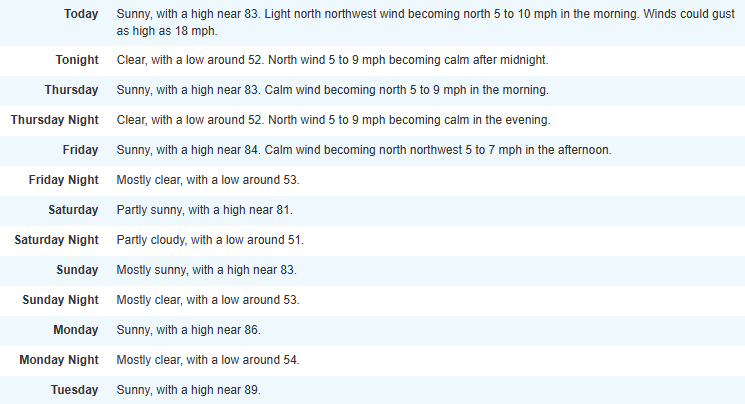
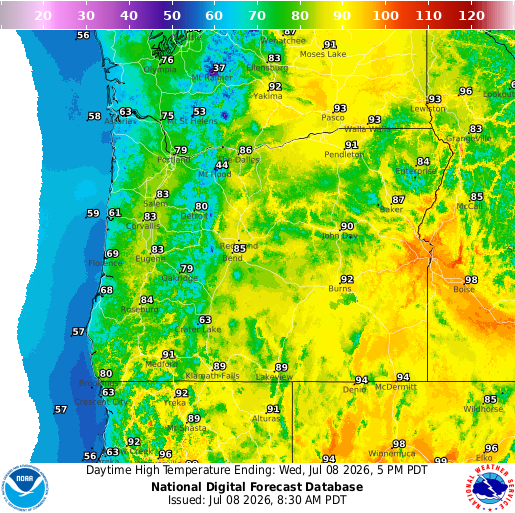

Be sure to check out what we’re predicting in your area: https://www.farmersalmanac.com/extended-forecast

Oregon Country Fair Getting Ready to Kick Off
· Here we are once again, approaching the best weekend in July!
  Not only are we just a couple of days away from the start of the 2026 OCF
  , but Mother Nature is doing her part as well.
 The forecast is calling for what could be the best Fair weather we’ve seen in years, with highs only in the 80s—perfect for spending the day exploring the Fairgrounds.
July 10, 11, 12, 2026 — 11:00am – 7:00pm

Grab your tickets before they’re gone, and we’ll see you there!

 Let’s go!
Ticket: https://www.oregoncountryfair.org/tickets/


Jewelry & Beadwork: Custom jewelry made using copper or silver wire shaped by the artist incorporating natural stones and beads. (Booth 181)




 If you’ve been waiting for a sign to grab your tickets, this just might be it! Great weather, great memories, delicious fair food

 , and the best weekend of the summer are almost here.
Annual three-day celebration in our magnificent wooded setting, offering the finest in entertainment, hand-made crafts, delectable food, and information sharing. Oregon Country Fair is a 501(c)(3) nonprofit, charitable, educational, and philanthropic organization dedicated to supporting local arts and culture.
There is so much to see and do at the Fair!
Come wander our woods and meadows and enjoy entertainment, food, and artisan-made crafts. Learn more about how we assist alter-abled fairgoers.
Partake in the savory meals and delectable treats from our food booths featuring specialties from around the world, as well as traditional favorites. All meals are prepared fresh on site.
There are amazing finds around every bend in the path. Shop with over 300 artisans that are selling their hand-crafted goods, some only available at the Fair. Everything sold at the Fair is handmade and sold directly to you by the maker.
Revel in the spectacle of the crowd and join in on the parade. The Fair is where you are encouraged to dress with flair and let your inner child romp with glee. Nothing beats the people watching at Oregon Country Fair.
Entertainment Along the Path — Every day features live entertainment on 17 stages from morning to night. From puppet shows to poets, folk tunes to flamenco, jugglers to jam bands, hip hop to High Step, dragons, unicorns, fairies and more, you’ll find it all at the Fair. Click here for a full entertainment list.
We can’t wait to see you at the Fair!  Tickets: https://www.oregoncountryfair.org/tickets/
Construction underway with $200 million expansion at the Eugene Airport that will double the size of the main concourse
Local and state leaders toured the “Lift Off EUG” expansion project on Tuesday. The project broke ground at the start of summer and will add 10,000 square feet to the main concourse area.
“It is really the entry point for our five-county region in the southern Willamette Valley,” Eugene Mayor Kaarin Knudson said. “So, it is important to Eugene, the capacity of this airport, but it’s really important to a much broader collection of communities that are served by this critical infrastructure.”
The expansion will increase parking capacity, upgrade baggage screening and repair runways and taxiways. Eugene Airport Director Cathryn Stephens said the airport has been operating over capacity for years.
“The Concourse A expansion that’s happening right now is kind of a relief valve for that it’s going to be doubling the size of our hold room or waiting areas providing a lot more seating,” Stephens said. “It’s going to be an overall better passenger experience for everybody.”
The Concourse A expansion is about a year away from completion. Most of the construction is outside of the terminal, so passengers shouldn’t notice many disruptions in the meantime.
A feasibility study is underway to determine the best funding method. The airport is considering a mix of airport revenue, state and federal grants and public-private partnerships. The airport will look to figure out a funding plan during the 2027 Legislative Session in January.
Pets Rescued Fire Early Morning Fire In Springfield

Springfield, OR. Eugene Springfield Fire responded to an RV fire at Eugene Mobile Village in Springfield’s Glenwood neighborhood early Wednesday. At aprox. 1:27 am fire crews were dispatched to reports of fire through the roof of an RV trailer. Engine 4 from 5th & Centennial arrived on scene reporting a working fire.
During the primary search of the trailer a cat and dog were rescued from the fire. The pets received care from paramedics on scene, both survived and are in care with the owner.
Two adults and a child have been displaced by the fire and are receiving the assistance of the Red Cross. The fire is currently under investigation.
Wildfire Reported in Three Sisters Wilderness
A new wildfire has ignited in the Willamette National Forest in Lane County near the county line north of Highway 58. The fire, dubbed 163 Mr. Fire, was reported around 3:30 p.m. July 7 in the Three Sisters Wilderness about 70 miles from Eugene.
Firefighters with the U.S. Forest Service are responding by rappelling as part of a full suppression strategy, according to a social media post. Firefighters aim to extinguish the fire along its perimeter. The fire is within the McKenzie River Ranger District and smoke could be visible in central Oregon communities.
Changes coming to Lane County’s rural waste transfer sites
Following a robust discussion, the Board of County Commissioners voted to close a $3 million budget gap in Lane County’s Waste Management Division by increasing fees and reducing some services.
“Our community values rural transfer sites, and they are an important part of our solid waste system,” said Waste Management Division Manager Jeff Orlandini. “We rely on the fees people and haulers pay when they bring us materials to fund our transfer sites and other services, but those revenues have declined sharply in recent years. These changes will allow us to balance our budget while preserving as many of our services as possible.”
The budget gap is the result of several years of waste exportation by Waste Connections, which owns Sanipac, EcoSort, and County Waste & Transfer. Historically, communities and solid waste haulers have helped fund transfer sites and other services, such as household hazardous waste collection and recycling programs, by paying a fee when they bring garbage to Lane County sites. By taking waste out of Lane County to a site owned by Waste Connections near Medford, Ore. Lane County is unable to collect enough fees to keep services at the current level and the Waste Management Division does not receive tax funding.
While haulers in unincorporated Lane County and the cities of Eugene, Florence and Oakridge are required to bring their waste to Lane County to support our local system, other cities have refused to require their haulers to do the same, including Cottage Grove, Creswell, Springfield, and Veneta.
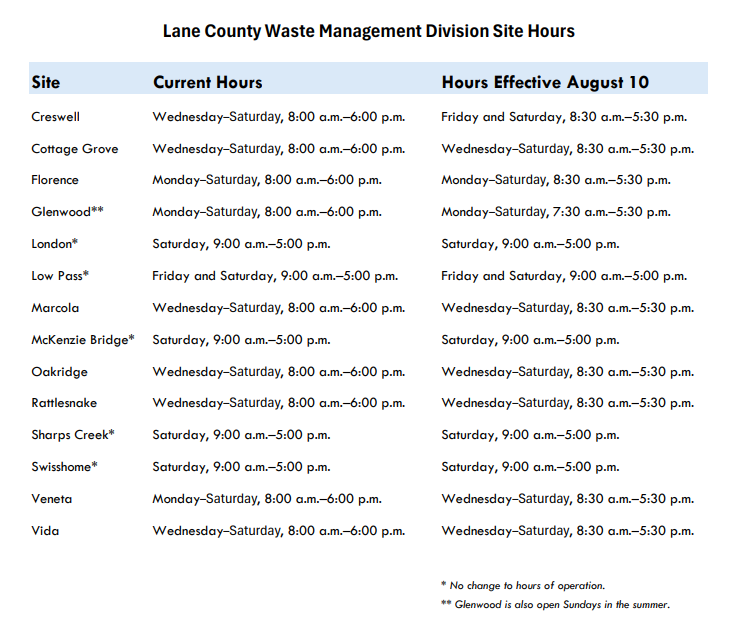
The changes adopted by the Board of Commissioners will take effect on Monday, August 10, 2026 and include three components: a fee increase, reduced hours at multiple locations, and closure of the Walton Transfer Site. After August 10, Lane County will still operate 14 solid waste transfer sites—more than any other county in Western Oregon—and the new minimum fee remains lower than Lane County’s five comparator counties, where minimum disposal fees range between $28 and $53.63.
Summary of changes that take effect on Monday, August 10:
- Fees
- The fees for using transfer sites will increase by 5 percent and the new minimum fee at all transfer sites will be $25 (formerly $15). There are no fee changes for municipal solid waste brought to Short Mountain Landfill by commercial haulers.
- There will no longer be a $1 discount for bringing recyclables.
- Reduced hours
- Creswell Transfer Site (34293 Cloverdale Road):
- Creswell will be closed on Wednesday and Thursday. It will be open Friday and Saturday from 8:30 a.m. to 5:30 p.m.
- Veneta Transfer Site (24444 Bolton Hill Road):
- Veneta will be closed on Mondays and Tuesdays. It will be open Wednesday–Saturday, from 8:30 a.m. to 5:30 p.m.
- Other transfer sites:
- Many other locations will have slightly reduced hours. See attachment.
- Creswell Transfer Site (34293 Cloverdale Road):
- Closures
- The Walton Transfer Site (18585 Transformer Road) will permanently close on August 10, 2026.

Catholic Community Services of Lane County, Inc. (CCS) · See Our Mission in Action: Join Us for an Insider’s Tour

Spend an hour getting a behind-the-scenes look at the programs and services that make a real difference in our community.
Date: Wednesday, July 29th  Time: 4:00 pm – 5:00 pm
  Location: 1025 G Street, Springfield
No fundraising here — just a chance to see our work firsthand and ask questions. Inspired by Christ’s call to love our neighbors as ourselves, Catholic Community Services of Lane County (CCS) lives out that mission every day — offering food, rent, utility, and housing assistance, emergency shelter, and support for refugees and immigrants resettling in Lane County.
For more than 74 years, CCS has stood beside the poor and unhoused in our community. Come see the impact for yourself — reserve your spot today! Questions or want to learn more? Email development@ccslc.org or call 541-345-3628 ext. 1317
Catholic Community Services of Lane County, Inc. (CCS) is with St. Paul Catholic Church Eugene Oregon and Emerald People’s Utility District. ·
 Back to School Drive – July 15 to August 15!

Help CCS support over 200 kids enrolled in our programs — most of whom will start the school year without the supplies they need. Together, we can change that!From July 15 to August 15, we’re collecting NEW school supplies to give these students a strong start. Most Needed Items (New Only):
 Notebooks & paper
 Watercolors & markers
 Water bottles
Backpacks
 Corded headphones
 Lunch bags… and moreYour donation can make a direct impact in a child’s life.
Find a complete list of supplies and a donation site near you and give today! www.ccslc.org/back-to-school-drive Let’s make sure every student walks into school confident, prepared, and ready to learn. 

 SAVE THE DATE!!! Michael Bryson 5 K Shuffle will be 8-8-26 At Alton Baker Park in Eugene Oregon at 9 am
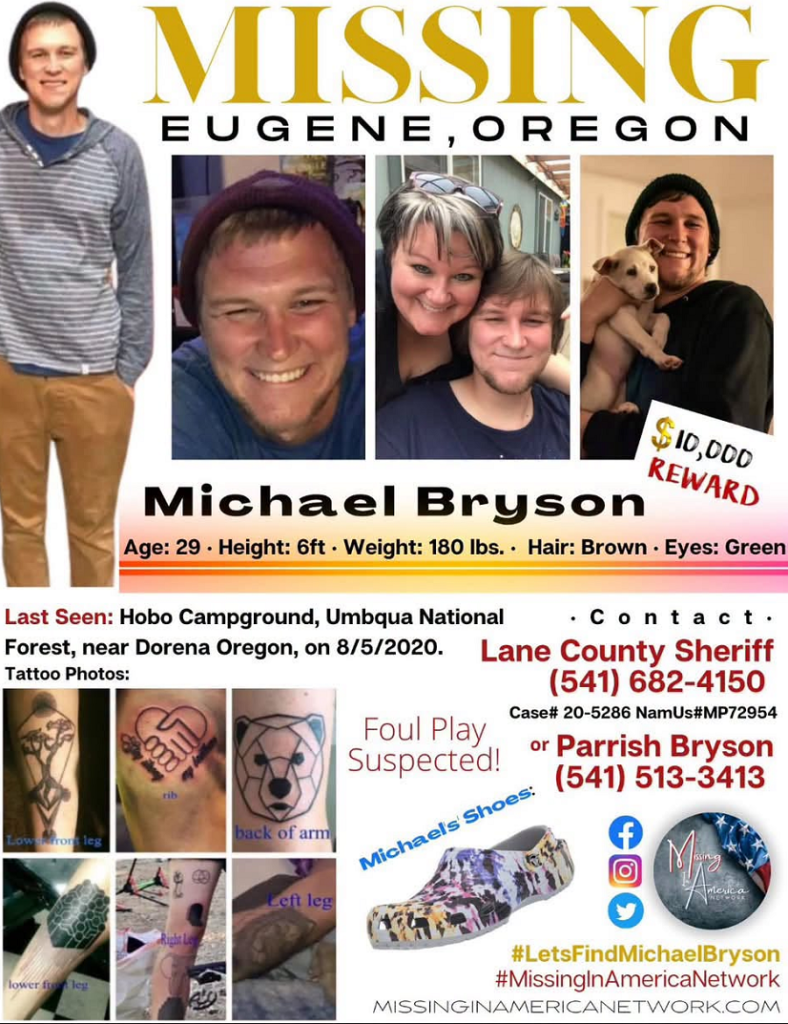
Sign up sheet will be up in a few days! – This will be the 5 th annual 5 K shuffle please come and show your support and love for Michael Bryson and all missing people! You can walk-Run-Shuffle! https://michaelbrysonfoundation.com/5k-shuffle-2026
Food for Lane County Summer Food Program for Kids
In partnership with PeaceHealth, which donated $50,000 to the program, and Yogi, a tea company that donated $5,000, the program will distribute free lunches at dozens of sites in Lane County from June 22 to Aug. 21.
Click on Lunch locations below:
Creswell Eugene Dexter Junction City Oakridge Springfield Thurston Triangle Lake Veneta
According to Carolyn Stein, the executive director of Food for Lane County, the PeaceHealth donation and Yogi donation helped minimize a funding gap of over $100,000. Even so, Food for Lane County has to pay out of pocket to fill the remaining gap.
According to the Oregon Department of Education, about 75% of Lane County children qualify for free or reduced-cost lunch.
Last year, Stein said the free-food program served about 50,000 meals to kids throughout the summer, and they expect that number to increase by an additional 10,000 this summer.
“Food for Lane County’s mission is to engage our community to create access to food, and we do that with many partnerships with organizations and businesses across the community,” Stein said. “We went to PeaceHealth because they have a shared value to make sure that no child in our community goes hungry and they stepped up in a big way to help us meet the need in our community.”
The lunches will be served on a first-come basis, between 11:30 a.m. and 12:30 p.m., Monday through Friday. Kids, 18 years old or younger, can receive meals, regardless of income.
Springfield Police Department – Oregon Incident: Child Sex Abuse
Location: Springfield, Oregon Case Number: 26-03630
INVOLVED SUSPECT: O’Neill, Patrick Corey 62-Year-Old Male | Springfield, OR
CHARGES: Sex Abuse I x 2, Sodomy I x 2, Unlawful Sexual Penetration
NARRATIVE OF INCIDENT: On June 9th at about 2145 p.m., Officers with the Springfield Police Department responded to a sex abuse allegation involving two young juvenile victims. The suspect was identified as Patrick O’Neill who primarily goes by the name Corey O’Neill. Corey was arrested on June 23rd, 2026, for the below charges and lodged at the Lane County Jail.
Corey was a known “bubble” performer in Eugene and Springfield who had access to children. He would perform in local parks and at the Eugene Country Fair. He also babysat for different families. If anyone has further information or concerns regarding Corey having contact with children, contact the Springfield Police Department at 541-726-3721.

Road Closure: Belknap Covered Bridge (McKenzie Bridge area)
Road name: East King Road
Location: Belknap Covered Bridge
Dates and times: Between7:30 a.m. and 4:00 p.m., Monday–Thursday, from June 22 through August 3
Alternate route: Cougar Dam Road to West King Road
Reason for closure: Scaffolding installation and painting.
Burrito Brigade Buys Building to Create Community Food Hub
Burrito Brigade has bought the old Center for Appropriate Transport building at 455 West 1st Ave. in the Whiteaker neighborhood to create a new community food hub.
The organization is asking the community to help support building renovation goals. Burrito Brigade needs $300,000 more to fully complete a commercial kitchen installation, food storage infrastructure, ADA-compliant upgrades and critical improvements needed.

Jennifer Denson says “This project has always been community driven. Since Waste To Taste’s start in 2020 we have not looked back. We just keep rescuing more food and growing more organized and it’s incredible to watch the impact and difference we make when we work together,”
Hundreds of volunteer hours weekly are dedicated to rescuing more than half a million pounds of food annually from grocery stores, small businesses, institutions, large food generators and local farms. This community-powered food rescue serves fresh local vegetables and fruit alongside diet and culturally specific products.
The no-barrier access free grocery store, known as Waste-to-Taste, provides households the ability to supplement other systems of support that often have eligibility requirements. Waste-to-Taste serves more than 10,000 households annually.
Rescued food is also redirected through other sustainable distribution channels. Food scraps and spoiled food are diverted to feed farm animals like chickens, goats and pigs, sanctuary animals at a local emu ranch and wolf rescue, and even a mealworm farm.
According to Burrito Brigade, the community connection and creativity around food in the kitchen includes partners in many mutual aid food projects facilitating hot meals, food preservation, community-led cooking classes, food micro-entrepreneurs and youth workforce training. The new community food hub will open its doors to the public in 2027. You can DONATE here: https://www.zeffy.com/en-US/donation-form/donate-to-help-us-build-a-food-hub

Skinner Butte Park summit parking lot is now closed to motorized vehicles due to fire danger. The closure will remain in effect until October.
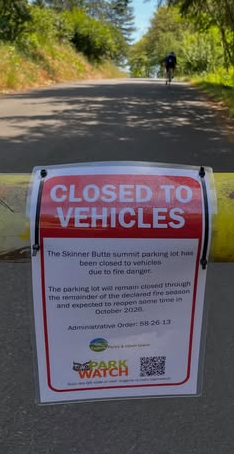
City of Eugene’s Parks and Open Space, in cooperation with Eugene Springfield Fire, have closed the Skinner Butte parking lot and summit road. It will be closed until sometime in October.
There has been a history of illegal firework activity and brush fires, particularly during the summer season.
Closing this area to vehicles helps reduce that risk. The summit will remain accessible to pedestrians and cyclists (no e-motorcycles) by numerous trails and the paved road that leads to the summit.
Trail improvements planned for Summit Trail at Mount Pisgah
Lane County Parks is upgrading the final half-mile segment of the Summit Trail at Mount Pisgah from Monday, June 8, through Wednesday, July 1. Work will be completed by Oregon Woods.
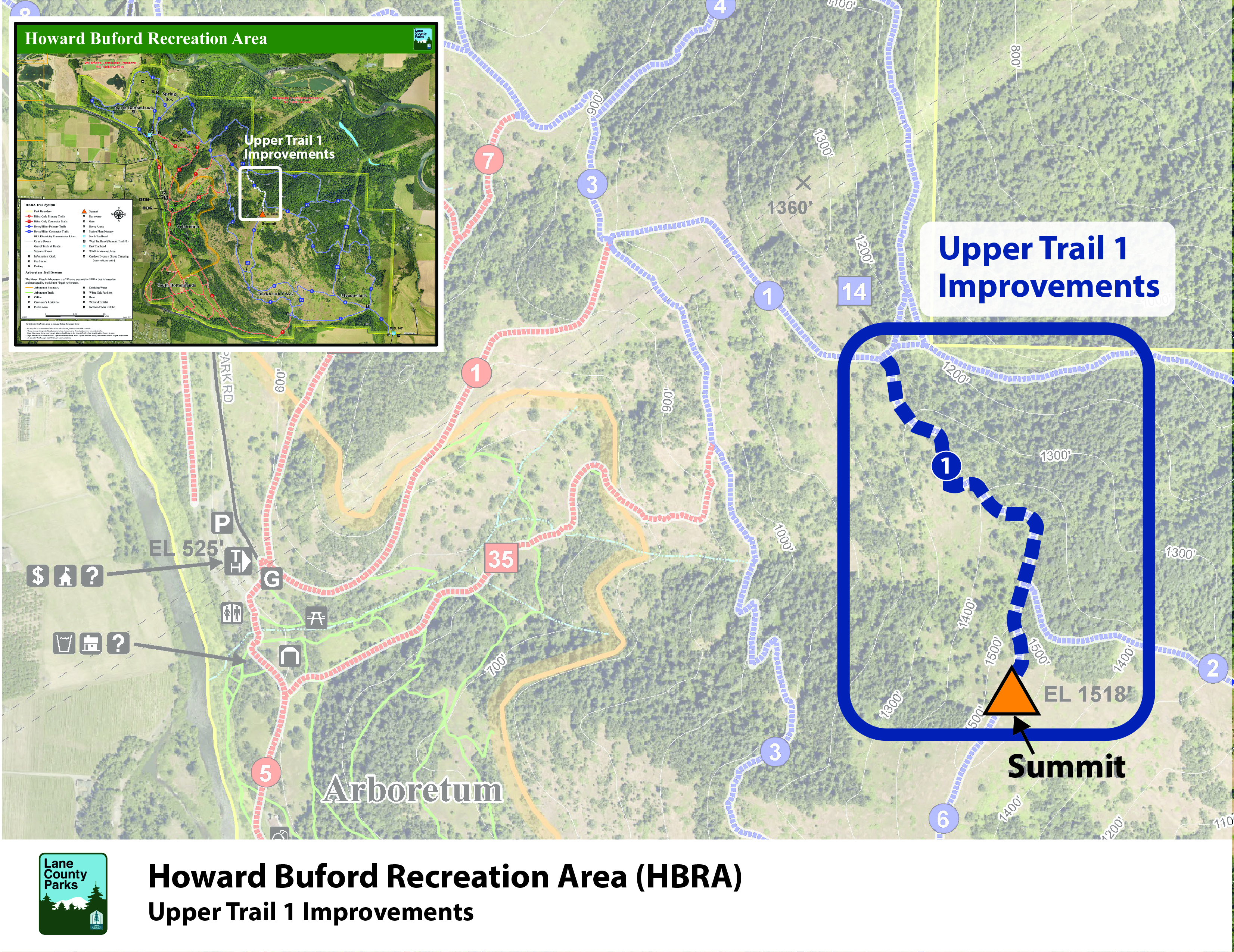
Improvements include the removal of large rocks and trail obstacles, construction of drainage features to reduce erosion, and placement of new gravel to improve trail stability, accessibility, and drainage. Crews will also level several narrow or uneven sections of trail. The project is designed to create a smoother, safer route to the summit while maintaining the natural character of the trail.
Please anticipate periodic trail closures, delays, and equipment on the trail during construction. Signs will be posted at trail access points to notify visitors of active work areas and temporary restrictions. Work will take place during favorable weather conditions and will focus on minimizing impacts to surrounding natural resources and trail users.
“We’re excited to make improvements that park users and accessibility advocates have been asking for,” said Lane County Parks Communications and Volunteer Coordinator Laura Linn. “The upgrades are about making one of Lane County’s most popular destinations more accessible to everyone, including all-terrain wheelchair users.”
This project is funded through the Parks Levy. For updates on trail access and project timing, follow Lane County Parks on Facebook or view the levy project map.
Deadline for temporary rent and utility assistance through ReOregon is June 30
The deadline for Intermediate Housing Assistance (IHA) for survivors of the 2020 Labor Day wildfires and straight-line winds is coming soon. Oregon Housing and Community Services (OHCS) administers IHA, which provides temporary rent and utility assistance for renters who lived in the disaster-affected counties of Clackamas, Douglas, Jackson, Klamath, Lane, Lincoln, Linn, or Marion at the time of the wildfires and have a verified loss.
Survivors have until June 30 to apply for the program, which has expanded eligibility, including higher incomes, so more households can get help. Assistance may last for up to 24 months or until the program’s funding is fully spent.
OHCS encourages any interested folks to reach out to a local community action agency to find out more and get started on an application.
“IHA provides a vital need for renters who are also wildfire survivors to help keep them stably housed as they figure out their permanent housing solution,” said Shannon Marheine, director of Disaster Recovery and Resilience at OHCS. “We encourage anyone who is eligible and hasn’t yet applied to do so as soon as possible. If you know someone might benefit from this program, please spread the word.”
IHA is part of a suite of wildfire recovery programs called ReOregon intended for survivors of the 2020 Labor Day Disasters and is funded by a $422 million Community Development Block Grant Disaster Recovery to support long-term recovery and rebuilding efforts.
So far, OHCS and its partners have successfully served 401 households with the IHA program.
To learn more about IHA and other ReOregon programs, visit OHCS’ website.
About Oregon Housing and Community Services – OHCS is Oregon’s housing finance agency. The state agency provides financial and program support to create and preserve opportunities for quality, affordable housing for Oregonians of low and moderate income. OHCS administers programs that provide housing stabilization. OHCS delivers these programs primarily through grants, contracts, and loan agreements with local partners and community-based providers. For more information, please visit: oregon.gov/ohcs.

Lane County will participate by setting up donation barrels for staff to donate at Lane County owned properties.
“Food for Lane County is already seeing high numbers of pantry visitors at a time when our food supply has been limited due to federal program cuts. We want all Lane County residents to have the food and resources they need to thrive, and we’re very concerned about the welfare of our community if SNAP benefits aren’t available.” said Food for Lane County Director of Development and Communications, Rebecca Sprinson.
For individuals and families in need of food, please visit the FFLC food finder, at:
Those interested in donating can do so by visiting: https://www.foodforlanecounty.org/ways-to=give/donate or by calling 541-343-2822.
$18.95 can help feed 120 people.
 Every weekend, the volunteer crew at Burrito Brigade rolls hundreds of delicious vegan burritos to help close the hunger gap here in Eugene. Each box of tortillas — just $18.95 — helps feed 120 neighbors.

Could you spare $18.95 to help? Even better — could you make it a monthly donation to keep those burritos rolling all year long?
Every dollar makes a difference in these times of need. Thank you for being part of the Brigade.  Donate here: https://www.zeffy.com/donation…/we-rise-by-lifting-others Support our Mission: BurritoBrigade.org

White Bird Clinic – · Crisis intervention is a 24/7 need in our community, and CAHOOTS, as part of White Bird Crisis Intervention programs, responds.
White Bird CAHOOTS Springfield Coverage: 11 am – 11 pm, 7 days a week (541-726-3714)
White Bird Clinic
This year marks 60 years of community health centers transforming care across the U.S. At White Bird Clinic, we’re proud to be part of this legacy – bringing whole-person care to our community’s most vulnerable neighbors for more than 50 years! From medical and dental services to harm reduction and crisis response, we’re here to meet people where they are.Learn more about community health at the link below: https://www.nachc.org/about-nachc/history-of-chc/
Whole Community News Report on CAHOOTS:
Since December of 2023, Eugene lost the University District hospital and the Hourglass Crisis Center, and as of last week, CAHOOTS. These were no-barrier treatment access points for our most vulnerable neighbors to receive care when experiencing a mental health crisis. READ MORE: https://wholecommunity.news/2025/04/20/public-comments-ask-city-not-to-lose-cahoots-too/

Contact for Services — Phone: CAHOOTS is dispatched within the Springfield urban growth boundary through the non-emergency number, 541-726-3714.
Starting in the new year, White Bird Dental Clinic will offer more walk-in clinic times. Currently, we offer walk-in clinics at 1415 Pearl St. every Monday and Wednesday at 7:30 a.m. In January, we will also add every other Friday at 7:30 a.m. Find more information at whitebirdclinic.org/dental
EWEB Emergency Water Stations
The final emergency water station has been officially installed in Eugene as part of the Eugene Water & Electric Board’s disaster preparedness plan.
This is where people can access water in case of earthquakes, wildfires, or other events that could disrupt or limit access to the city’s water system.

Other locations are the Eugene Science Center, Howard Elementary School, Prairie Mountain School, Amazon Park-YMCA, the Sheldon Fire Station, and the Lane Events Center and Fairgrounds.
All seven locations across the city of Eugene draw their water from underground wells. The intent is to provide individuals up to two gallons of water a day during an emergency. MORE INFO at EWEB: https://www.eweb.org/projects/emergency-water-stations
Oregon Food Bank · Find free food sites near you using OregonFoodFinder.org.
If you can’t make it to a food location, someone else can pick up food for you.You will just need to print and fill out the Authorized Representative form at https://lnkd.in/dsskUpkQ, and have them take it with them to the food sites. You can find step-by-step instructions at https://lnkd.in/dVBRxn-A.
Worried about recent changes or losing assistance?
Here are resources that can help:
211Info: Dial 2-1-1 or visit the211Info food webpagefor information and referrals to more than 1,500 food resources across Oregon.
Oregon Food Bank: Use the Oregon Food Bank’s Food Finder Mapto find over 100 food pantries, free food markets or hot meal programs near you.
Aging and Disability Resource Connection of Oregon (ADRC): Call 855-673-2372 or visit theADRC food webpage to find local meal programs and food boxes in your area.
Summer EBT is back to help feed Oregon children during summer break
The Oregon Summer Electronic Benefits (Summer EBT) program is returning in 2026 to help families buy groceries for school-aged children during summer break when they don’t have easy access to healthy meals.
Eligible families can receive a one-time payment of $120 for each child on an Oregon EBT card to buy food. Unused benefits can expire 122 days after they are issued.
Families will get benefits automatically on their Oregon EBT card if they have children between the ages of 6-18 and received one of the following at any time during the 2025-26 school year:
- Supplemental Nutrition Assistance Program (SNAP) food benefits
- Temporary Assistance for Needy Families (TANF) cash assistance
- Medicaid, if household income is below 185 percent of the federal poverty level
- Foster care services
Families also may automatically receive benefits if they have children who:
- Were determined by their school to have a status as migrant, houseless or runaway.
- Took part in the Food Distribution Program on Indian Reservations.
- Attended a Head Start program that was part of the National School Lunch Program or School Breakfast Program.
Families may need to apply if:
- Their household meets income requirements for free or reduced-price school meals.
- Their child attends a school that was part of the National School Lunch Program (NSLP) or School Breakfast Program (SBP).
Important Summer EBT dates:
- June 1, 2026 – The Summer EBT call center opens. Families can call 833-673-7328 weekdays from 8 a.m. to 5 p.m.
- June 4, 2026 – Benefits are expected to begin issuing to families who are automatically eligible.
- June 5, 2026 – The online application opens and applications begin processing.
- Sept. 1, 2026 – Application deadline.
- Sept. 25, 2026 – The Summer EBT call center closes.
The Summer EBT program is administered by the Oregon Department of Human Services (ODHS) and Oregon Department of Education (ODE).
Children cannot receive 2026 Summer EBT benefits in multiple states. The program invites families to apply if they have children living in Oregon during the 2025-26 school year.
Families can learn more about Summer EBT, find application information and get updates by visiting the website at sebt.oregon.gov.

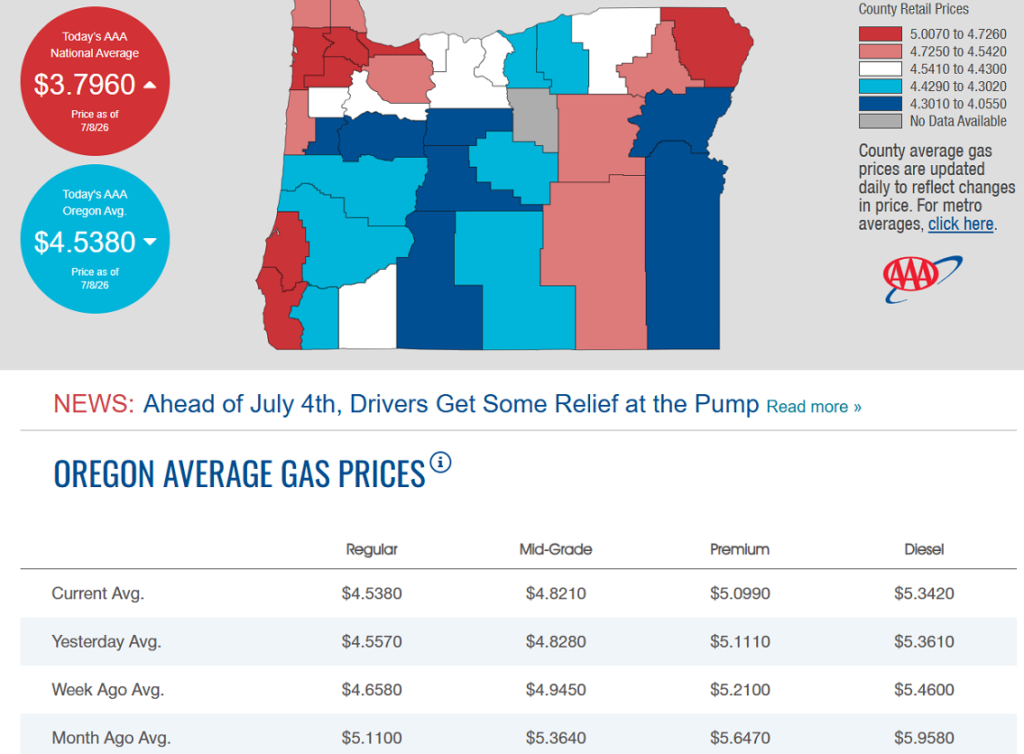
7/8/2026 — Gas Prices in Oregon Today
Oregon expands Medicaid to help some members buy groceries
Some Oregon Health Plan members can now get help buying groceries under a new Medicaid benefit that state officials hope will improve people’s health and keep them out of the hospital.

Starting this month, Oregon Health Plan members who have certain serious medical conditions and struggle to afford enough food can apply to receive up to six months of nutrition benefits through one of two new programs.
One covers fruits and vegetables. The other helps pay for pantry staples such as meat, fish, dairy products, bread, cooking oils, canned foods and spices.
The grocery benefits are the latest addition to Oregon’s health-related social needs initiative, an ambitious effort that has expanded what Medicaid pays for beyond traditional medical care.
In 2022, Oregon won federal approval to use Medicaid dollars for services such as housing assistance, medically tailored meals, nutrition education and climate-related equipment, including air conditioners and air filters for people whose health is threatened by extreme heat or wildfire smoke.
Dr. Sejal Hathi, director of the Oregon Health Authority, said the latest nutrition benefits serve as another “important tool to help people stay healthy.”
“When people have reliable access to nutritious food, they can better manage their health, which reduces emergency visits, lowers hospital readmissions and helps bring down medical spending overall,” she said in a statement.
Oregon health officials did not immediately say Wednesday how many Medicaid members they expect will qualify for the new nutrition benefits.
The benefit expansion comes as fewer Oregonians are receiving help buying groceries through the federal Supplemental Nutrition Assistance Program, or SNAP.
About 708,000 Oregonians received SNAP benefits in April, roughly 70,000 fewer than a year earlier. The decline has been steeper than state officials expected after President Donald Trump signed H.R. 1, which reduced federal spending on SNAP and Medicaid.
Dr. Margaret Cary, the Oregon Health Plan’s behavioral health medical director, said the new Medicaid nutrition benefits were never intended to replace SNAP.
“We know this is not going to solve hunger in Oregon. That’s not Medicaid’s role,” Cary said.
Still, she said, some Oregonians who have lost SNAP benefits or are receiving less food assistance could qualify for the new Medicaid program if they also meet its medical and eligibility requirements.
The latest nutrition benefits are available only to a narrow group of Oregon Health Plan members who have low or very low food security, meet certain medical requirements and are in qualifying situations, such as homelessness, recent incarceration or treatment, or involvement with Oregon’s foster care system.
The new pantry-stocking program is even more limited, with eligibility restricted to pregnant people, young children, young adults with special health care needs and certain older children and young adults with complex health needs.
Oregon Health Plan members can receive only one of the two benefits at a time, although they may apply for the other after the first benefit ends if they are still eligible.
Depending on where they live and which health plan they belong to, members will receive either grocery boxes delivered to their homes or prepaid cards they can use to buy approved foods at participating stores. The benefits last up to six months.
State officials did not immediately provide the average dollar value of the benefits. But Cary said they’re meant to supplement, not replace, a household’s grocery budget.
Members enrolled in coordinated care organizations can apply through their health plan. Those in Oregon’s fee‑for‑service Medicaid program, known as Open Card, can request benefits through the state’s contractor, Acentra, by calling 1-888-834-4304.
This story originally appeared in The Oregonian/OregonLive: Oregon expands Medicaid to help some members buy groceries – https://oregoncapitalchronicle.com/2026/07/07/oregon-expands-medicaid-to-help-some-members-buy-groceries/
ODHS program waives tuition and fees for young people who have experienced homelessness
Young people in Oregon who have experienced homelessness and are pursuing higher education at eligible Oregon schools are eligible for the Oregon Department of Human Services, Youth Experiencing Homelessness Program Tuition and Fee Waiver Program.
“College can feel out of reach for young people who have experienced homelessness, and this program tells them that Oregon knows their future is worth investing in,” said Matthew Rasmussen (he/him), manager of the ODHS Youth Experiencing Homelessness Program.
“The tuition and fee waiver program means opportunity,” said Bell Cambridge (she/her), a recipient of the waiver and member of YEHP’s Youth Action Board. “It is an opportunity to pursue a meaningful future and a career that I never thought possible for myself or others like me. For a long time, I believed I wasn’t able or worthy enough to get the chance to pursue higher education. This program changes that. It grants youth who have been disproportionately disadvantaged a genuine chance to break the cycle. By providing access to stability and opportunity, it represents an investment in my future and a validation that my abilities and potential are not limited by my circumstances.”
Who can apply — Young people under the age of 25 who experienced unaccompanied homelessness for at least six months between ages 14 and 24, and received services when they were 16 or older from a Youth Experiencing Homelessness Program partner are eligible to apply.
There is no deadline to apply, but applicants must also have completed the Free Application for Federal Student Aid (FAFSA) or the Oregon Student Aid Application (ORSAA). They must also be enrolled in at least one course credit towards their undergraduate degree at an Oregon public university or community college and be in good academic standing.
How to apply — Visit the ODHS Resources for Youth Experiencing Homelessness webpage for more information about the waiver program and applications. Applications are available in English and Spanish.
Young people can also request help with the application from the ODHS Youth Experiencing Homelessness Program.
How it works — The waiver covers tuition for academic credit courses, mandatory enrollment fees, one-time fees, and course fees for students pursuing a two-year or four-year undergraduate degree at an Oregon public university or community college. It is a waiver of last resort, meaning it waives any tuition and fees remaining after all other federal, state and institutional grants and scholarships have been applied.
Some financial aid sources such as loans, the Chaffee Education and Training Grant, and non-tuition scholarships from sources outside of the college, will not reduce the amount of tuition and fees waived.
More information — More information can be found online at the ODHS Resources for Youth Experiencing Homelessness webpage:
- Program Information in English and Español
- FAQs in English and Español
- Application in English and Español
The ODHS Youth Experiencing Homelessness Program Tuition and Fee Waiver Program is made possible by House Bill 4013 passed during the 2022 Session of the Oregon Legislature.
About the Oregon Department of Human Services — The mission of ODHS is to help Oregonians in their own communities achieve wellbeing and independence through opportunities that protect, empower, respect choice and preserve dignity.
Sky Lakes Medical Center has become the first hospital in Oregon to receive the American Hospital Association’s Foster G. McGaw Prize for Excellence in Community Service, recognizing its efforts to improve health throughout the Klamath Basin.
The hospital will receive the $100,000 award on July 13 at the AHA Leadership Summit in Denver.
Sky Lakes says it will invest the entire award back into the community. Working with more than 50 local partners through the Healthy Klamath Network, the hospital has expanded wellness programs, helped reduce smoking rates, increased access to fresh local food, created new parks and bike paths, and developed healthcare career programs for local students.
Klamath County is a geographically expansive rural community in south-central Oregon that faces significant health and socioeconomic challenges. More than 20% of residents live below the federal poverty level, approximately 76% rely on Medicare or Medicaid for health coverage, and 16% experience food insecurity, factors that contribute to some of the state’s most challenging health outcomes.
“What we’re doing is changing the dynamic in the Klamath Basin and making a significant impact on the quality of life for the people of Klamath County,” Merritt Driscoll, executive director of the Sky Lakes Foundation. “We’re making this a place where people want to come to live, work, learn and play.”
The Foster G. McGaw Prize is sponsored by the Baxter Foundation, the philanthropic arm of Baxter International, and is administered by the American Hospital Association.The American Hospital Association praised Sky Lakes for its innovative partnerships and commitment to improving health in rural southern Oregon and northern California.
Sky Lakes Medical Center is a nonprofit health system serving the Southern Oregon region.
Webinar series to honor 36 years of disability civil rights kicks off July 7
— The public is invited to a series of free webinars featuring conversations with disabilities advocates and experts who will share the latest information on disability supports, emergency management systems and digital accessibility.
Topics by date are:
- July 7: Exploring Cross-Disability Experiences and Support Needs
- July 14: Building Inclusive and Accessible Emergency Management Systems
- July 21: ADA: How Far We’ve Come and What Comes Next
- July 28: Understanding the Department of Justice’s (DOJ) Ruling on Digital Accessibility
The free weekly webinar series is being hosted by Oregon Disabilities Commission (ODC), Oregon Department of Human Services, Northwest ADA Center and Disability Rights Oregon in recognition and celebration of the 36th anniversary of the Americans with Disabilities Act (ADA).
“As we reflect on the legacy of the Americans with Disabilities Act, we’re also looking closely at the work ahead such as understanding diverse experiences and support needs, strengthening inclusive and accessible systems, and advancing digital accessibility,” said Mark King, Chair of ODC. “We’re grateful to our co-hosts for joining us in presenting this series, which helps us continue educating and advocating for equity, independence and full participation for people with disabilities.”
The series will take place on Tuesdays throughout July, from 11:30 a.m. to 1 p.m. Pacific Time, beginning July 7. The sessions are open to the public, and registration is now available through the event webpage on Zoom.
The series will be accessible to people with disabilities and will be translated into Spanish. Captioning and American Sign Language interpretation will also be provided. For questions about accessibility for the webinar series, or to request an accommodation, contact OregonDisabilities.Commission@odhsoha.oregon.gov.
More information about the series, including presenter biographies, will be shared on the Oregon Department of Human Services ADA event webpage.
About the Oregon Disabilities Commission: The Oregon Disabilities Commission is charged by state statute to advise the Oregon Department of Human Services, the Governor, the Legislative Assembly and appropriate state agency administrators on issues related to achieving the full economic, social, legal and political equity of individuals with disabilities. ODC also acts as a coordinating link between and among public and private organizations serving individuals with disabilities.
In a new study the state of Oregon has ranked third in the US for extreme heat death rates, putting the state behind only Arizona and Nevada in a stark national comparison.
Data specialists analyzed public mortality data and found Oregon recorded 133 heat-related deaths in 2021, equal to an age-adjusted rate of 2.4 deaths per 100,000 people.
That put Oregon above Washington and Louisiana in the five highest-rate states where enough deaths were recorded for a stable state comparison.
The ranking comes with heat safety again front of mind in July, when long hot spells can hit Portland, Salem, Eugene, Medford and smaller communities where not every home is built for sustained high temperatures.
The five states where people were most likely to die from extreme heat were:
- Arizona, 426 deaths, 5.2 deaths per 100,000 people, 2021, public mortality data
- Nevada, 166 deaths, 4.6 deaths per 100,000 people, 2021, public mortality data
- Oregon, 133 deaths, 2.4 deaths per 100,000 people, 2021, public mortality data
- Washington, 171 deaths, 1.9 deaths per 100,000 people, 2021, public mortality data
- Louisiana, 38 deaths, 0.7 deaths per 100,000 people, 2021, public mortality data
Arizona was far ahead of the rest of the country, with a rate more than twice Oregon’s. Nevada was second, while Oregon’s 2.4 per 100,000 rate placed it firmly in the highest-risk group.
The national rate was much lower, at 0.4 deaths per 100,000 people in 2021, with 1,600 heat-related deaths recorded across the US.
Oregon’s place in the ranking shows the danger is not confined to desert states. The Pacific Northwest has historically been associated with milder summers, but the 2021 heat events showed how deadly extreme temperatures can become when they hit places where many households, older buildings and vulnerable residents are less prepared.
One researcher added this: “Extreme heat should be treated as a serious public safety issue, not just an uncomfortable part of summer. The figures show that sudden or prolonged heat can become fatal quickly, especially for older adults, very young children, people with chronic health conditions and anyone without reliable access to cooling. “
Sources: CDC Morbidity and Mortality Weekly Report, National Vital Statistics System Multiple Cause of Death File checked July 6, 2026. CDC Heat and Health Tracking Program, checked July 6, 2026. USAFacts analysis of CDC heat mortality data, checked July 6, 2026.
New services available statewide for early learning providers to ensure children stay in care
– The Oregon Department of Early Learning and Care (DELC) announces that Every Child Belongs(ECB) services are available statewide to licensed child learning and care providers.

Every Child Belongs, which was created in 2021 through House Bill 2166, supports early childhood educators in building nurturing and responsive environments to ensure children can stay in care. These supportive services align with a new state law created by Senate Bill 236 that takes effect July 1, 2026, which prohibits suspensions and expulsions in early learning settings.
“These laws are an opportunity to build an early learning culture where every child thrives, every family belongs, and every provider has the support they need,” said Alyssa Chatterjee, DELC Director. “We know that early interventions have the greatest impact, yet providers often tell us they struggle to access the resources they need when children in their care are facing challenges. With Every Child Belongs expanding its support statewide, early childhood educators have more help than ever to create safe, caring environments where young children can learn, grow, and succeed.”
Every Child Belongs services launched in 2025 as a pilot in three regions: Washington County, Marion, Polk, and Yamhill Counties, and Central Oregon (Deschutes, Crook and Jefferson Counties), providing strength-based strategies to early learning professionals. DELC worked with system partners to improve with each phase. The final three regions came online in March to complete full statewide coverage in all 15 regions.
“Every Child Belongs is already making a positive difference in Central Oregon,” said Karen Prow, Child Care Resources Director, NeighborImpact. “Early educators across our region are working hard to support children with increasingly complex social and emotional needs, and this program gives providers the training, tools, and confidence to respond effectively. When we invest in growing the skillset of educators, that knowledge stays with them for life—and benefits every child who walks through their door.”
Workers Can Use Paid Leave Oregon to Care for Loved Ones with Alzheimer’s
— During Alzheimer’s & Brain Awareness Month, Paid Leave Oregon is reminding workers they may qualify for paid family leave when they need time away from work to care for a loved one with Alzheimer’s disease.
Alzheimer’s and dementia affect thousands of Oregon families. About 79,000 Oregonians age 65 and older are living with Alzheimer’s, and 188,000 family caregivers provide an estimated 291 million hours of unpaid care across the state each year.
“Caring for a loved one with Alzheimer’s means going to appointments, helping with daily needs, or stepping in when a care plan suddenly changes,” said Andrew R. Stolfi, director of the Oregon Employment Department. “Paid Leave Oregon helps ensure workers do not have to choose between a paycheck and being there for a loved one who needs care.”
Paid Leave Oregon provides paid time off for eligible workers who need to care for a family member with a serious health condition. Alzheimer’s disease is specifically named in Oregon’s administrative rules as an example of a condition that may involve permanent or long-term incapacity. Eligibility depends on the worker, the need for leave, and verification from a health care provider.
“Paid Leave Oregon recognizes that caregiving is not one-size-fits-all,” said Juan Serratos, director of Paid Leave Oregon. “For some families, care may mean taking full weeks away from work. For others, it may mean taking a day at a time for appointments, safety needs, or changes in care. As the disease progresses, care needs change. Paid Leave is designed to help eligible workers take the time they need when a serious health condition affects someone they love.”
Under Oregon’s rules, care can include physical assistance with basic medical, daily living, safety, or nutritional needs; transportation to a health care provider; comfort or reassurance; administrative tasks; or arranging changes in care.
Workers can take Paid Leave in full weeks or one day at a time, allowing Oregonians to tailor their leave to their loved one’s needs. Paid Leave Oregon’s definition of family member includes many relationships, including spouses and domestic partners, children, parents, siblings, grandparents, grandchildren, and any person connected to the worker like a family member.
Workers who think they may need leave should inform their employer, gather documentation from a health care provider, and apply through Frances Online.
To learn more or apply, visit paidleave.oregon.gov.
About Paid Leave Oregon — Paid Leave Oregon provides temporary, paid time away from work so employees can have financial security when experiencing significant life events. Covered events include welcoming a new child, recovering from a serious health condition, caring for a family member with a serious health condition, or addressing issues related to sexual assault, domestic violence, stalking, or harassment. Paid leave benefits help Oregonians stay connected to their jobs and maintain financial stability during these major personal events. Learn more at paidleave.oregon.gov.
The Oregon Employment Department (OED) is an equal opportunity agency. OED provides free help so you can use our services. Some examples are sign language and spoken language interpreters, written materials in other languages, large print, audio, and other formats. To get help, please call 503-947-1444. TTY users call 711. You can also send an email to communications@employ.oregon.gov.
El Departamento de Empleo de Oregon (OED) es una agencia de igualdad de oportunidades. El OED proporciona ayuda gratuita para que usted pueda utilizar nuestros servicios. Algunos ejemplos son intérpretes de lengua de señas e idiomas hablados, materiales escritos en otros idiomas, letra grande, audio y otros formatos. Para obtener ayuda, por favor llame al 503-947-1444. Usuarios de TTY pueden llamar al 711. También puede enviar un correo electrónico a communications@employ.oregon.gov.
Enjoy outdoors, avoid bites: OHA shares summer mosquito prevention reminder
Simple steps can reduce risk of serious mosquito-borne illnesses
—As mosquito activity increases during the summer months, Oregon Health Authority (OHA) is reminding residents and visitors to take precautions against mosquito bites and reduce exposure to West Nile virus, the most common mosquito-borne disease in the state.
Mosquitoes carrying West Nile virus are detected in Oregon every year, primarily in eastern and southern parts of the state, though infected mosquitoes have been found throughout the Pacific Northwest. Public health works closely with local vector control districts to identify areas where the virus is circulating in the mosquito population.
West Nile virus is primarily spread through the bite of an infected mosquito. The virus can infect humans, birds, horses and other animals. Mosquitoes become infected after feeding on infected birds and can then spread the virus through subsequent bites.
“Summer is a great time to enjoy Oregon’s outdoors, but it’s also the time of year when mosquito activity is at its highest,” said Emilio DeBess, D.V.M., public health veterinarian at OHA’s Public Health Division. “Most people infected with West Nile virus may not develop symptoms, but some can become seriously ill, especially those over 50. Taking a few simple precautions can significantly reduce your risk.”
About one in five people infected with West Nile virus develop a fever and flu-like illness that can include headache, body aches, joint pain, vomiting, diarrhea or rash. Adults 50 and older, people with weakened immune systems, and those with certain underlying health conditions are at greater risk for severe illness. In rare cases, the virus can cause severe neurological disease affecting the brain or nervous system.
People experiencing a high fever, severe headache, stiff neck, confusion, muscle weakness, tremors or paralysis should contact a health care provider right away.
Here are tips to reduce breeding sites at home:
- Eliminate standing water around potted plants.
- Empty water from buckets, birdbaths, pet dishes and other containers at least once or twice each week.
- Clean clogged gutters and drainage areas.
- Remove old tires, unused containers and outdoor debris that can collect water.
- Regularly inspect areas under decks and shrubs, and around outbuildings where water may accumulate.
Tips to protect yourself outdoors:
- Use an EPA-registered insect repellent and follow label instructions.
- Wear long-sleeved shirts, long pants and socks when mosquito activity is high.
- Consider limiting outdoor activities during dawn and dusk, when mosquitoes are most active.
- Use mosquito netting over infant carriers and strollers.
- Repair or install window and door screens to keep mosquitoes out of homes and buildings.
Additional information about West Nile virus, mosquito prevention and surveillance activities in Oregon is availableon OHA’s West Nile virus webpage.
Bat confirmed positive for rabies in Benton County

Public health officials from the State of Oregon and the Benton County Health Department have confirmed that a local bat has tested positive for rabies. This is the first positive bat for rabies in Benton County in 2026.
On June 15, Benton County’s Environmental Health program learned that a resident found a bat, which may have had contact with their domestic animals, on their property in Benton County. The resident brought the bat to the Oregon State Veterinary Diagnostic Laboratory for testing. On June 17, the bat was confirmed positive for the rabies virus.
“Rabies is present in the bat population and bats are the primary reservoir of rabies in wild animals for our area of the country,” said Robert Baker of Benton County Environmental Health. “Direct hand contact with bats should always be avoided if possible.”
— Bats play an important role in our ecosystem and are especially helpful to humans by eating a lot of insects considered pests. While most bats do not have rabies and people cannot get rabies from just seeing a bat or having contact with bat guano (feces), it is important not to take unnecessary risk. Infected bats can pass the rabies disease to humans and other animals by biting or scratching, or through saliva contact with eyes, nose, mouth or an open wound.
- Avoid all direct contact with bats, whenever possible.
- If you must handle a bat, use sturdy gloves and/or a tool, like a shovel
- If a bat bites someone, contact Benton County Environmental Health at 541-766-6835 within a 24-hour period. If you can, try to safely capture the bat so we can have it tested for rabies.
- Make sure your pets are vaccinated against rabies
“All pet owners should make certain that their dogs and cats are vaccinated against rabies. Protecting pets from rabies can provide a buffer zone of immune animals between humans and rabid wild animals such as bats,” said Emillio DeBess DVM of the Oregon Health Authority (OHA).
— Rabies is a viral disease that is preventable, but deadly if people don’t receive medical care before symptoms start. Rabies spreads primarily through bites or scratches from an infected animal.
Rabies symptoms in animals can include lethargy, walking in circles, and loss of muscular coordination, convulsions, irritability, aggressiveness, disorientation, excessive drooling and showing no fear of humans. Animals displaying these behaviors should not be approached or handled.
Contact Benton County Environmental Health at 541-766-6835 whenever there has been human or pet contact with bats or any animal that appears to be sick, injured or has bitten a human or pet.
More information about bats and rabies can be found on Benton County’s animal bites webpage, OHA’s rabies webpage, and the Centers for Disease Control’s (CDC) rabies webpage.
Benton County Health Department — The Benton County Health Department is committed to protecting the health and well-being of everyone who lives in, works in, or visits Benton County. The Benton County Health Department focuses on preventing health problems before they occur. Their programs strive to create community conditions that help reduce health disparities, so all people have an equal chance for a long and healthy life.
Wildlife Crossing Projects Gain Momentum Across Oregon

Every year, thousands of deer, elk, bear, and other wildlife attempt to cross busy roadways in search of food, water, and mates. Too often, those crossings end in tragedy for wildlife and sometimes for motorists.
Improving habitat connectivity is one of Oregon Wildlife Foundation’s conservation priorities. Proceeds from the sale and renewal of the Watch for Wildlife specialty license plate are allocated to habitat connectivity and wildlife passage projects throughout Oregon.
The Foundation also serves as the fiscal sponsor for multiple passage projects – providing fiscal administration and fundraising support to these initiatives throughout their development.
“Our participation in wildlife passage work began in 2017 with an undercrossing on Highway 97 in Central Oregon” said Tim Greseth, Executive Director of the Oregon Wildlife Foundation. “This experience deepened our understanding of the impact that wildlife-vehicle collisions are having on many different species and led us to adopt habitat connectivity as an organizational priority.”
Recent project milestones include:
Bend to Suttle Lake Wildlife Passage Initiative (Central Oregon)
This section of Highway 20 experiences the highest frequency of deer and elk collisions in Oregon. The Bend to Suttle Lake Wildlife Passage coalition has completed a Phase I wildlife crossing mitigation study and developed conceptual crossing designs for multiple locations along the corridor.
Following that work, four wildlife overcrossings were identified as the highest priorities for Phase II design and engineering. The coalition has raised more than $850,000 in non-federal matching funds in preparation for the Federal Highway Administration’s Wildlife Crossing Pilot Program, which is slated to open for applications sometime in July or August.
Wallowa County Wildlife Crossing Project (Northeast Oregon)
The Wallowa County Wildlife Crossing Coalition has completed a Phase I study of Highway 82 between Enterprise and Wallowa to determine priority crossing locations and develop conceptual designs to reduce wildlife-vehicle collisions and improve habitat connectivity within this high-risk corridor.
Interstate 84 Wildlife Crossing Project (Northeast Oregon)
Interstate 84 is an almost permanent barrier to wildlife movement. The focus of this project is the completion of a wildlife crossing study and conceptual design for the highest priority locations on I-84 between Pendleton and La Grande. The funding needed to begin this project has been raised, marking an important step in its development.
Wanaket Wildlife Area Wildlife Crossing Project (Northeast Oregon)
In partnership with the Confederated Tribes of the Umatilla, Oregon Wildlife Foundation is providing funding support and serving as the fiscal sponsor for a wildlife crossing study on the Wanaket Wildlife area, which is located along the Columbia River, just east of McNary in northeast Oregon. The wildlife area is bisected by Highway 730 and the incidence of vehicle strikes is high within this section of road.
Assessing Existing Bridges and Culverts Across Oregon (Statewide)
Oregon Wildlife Foundation has retained a consulting team to evaluate existing bridges and culverts throughout Oregon that may already be in use by wildlife or, with modifications, can be improved or made ready for wildlife to use – all in service of keeping animals off busy roads by providing them with safe alternatives.
The consulting team is evaluating existing conditions at culverts and bridges large enough to accommodate deer and elk, documenting evidence of wildlife activity, and recommending cost-effective modifications that may increase use by wildlife.
“Building new wildlife overcrossings and undercrossings can be expensive, so we’re enthusiastic for opportunities to provide safe passage for animals through simpler modifications to the areas around existing bridges and culverts wherever and whenever possible,” said Greseth.
To learn more about Oregon Wildlife Foundation’s wildlife crossing initiatives or to support this work through the Wildlife Movement and Migration fund, visit www.myOWF.org/wildlifemoves. Or donate directly viahttps://secure.givelively.org/donate/oregon-wildlife-foundation/wildlife-migration-and-movement-fund-formerly-known-as-watch-for-wildlife-fund
Check out Oregon State Parks with your library card
Borrow an Oregon State Parks parking permit for free at 82 libraries statewide.

– Oregon Parks and Recreation Department (ORPD) and the State Library of Oregon are partnering to offer free state parks parking permits to Oregon public libraries. There are currently 200 parking permits available at 82 libraries across the state.
“Oregon’s state parks are for everyone,” said OPRD deputy director JR Collier. “As we assess ways to manage our budget responsibly, we also want to uplift equitable access to our parks.”
Each participating library received up to four parking permits. These are the physical hang tags you check out from the library and put in your car. The permit covers parking in all Oregon State Parks day-use areas for one vehicle. Go to the Oregon State Parks website to find participating libraries. All you need to participate is your library card.
“Libraries help make life more affordable for Oregonians. This program leverages the existing borrowing system to help connects folks of all income levels with the beauty and splendor of Oregon’s State Parks,” said Wendy Cornelisen, State Librarian.
Both OPRD and the State Library contributed 100 parking permits to the program to distribute to libraries. The agencies determined how many passes each library would receive based on interest from the library, its proximity to a park charging a day use fee, and the size of the population it serves. The State Library purchased permits with Library Services and Technology Act funds from the federal Institute of Museum and Library Services.
OPRD first distributed parking permits to 28 libraries as part of a year-long pilot program starting in August 2024. Those passes were checked out more than 2,100 times. At the pilot’s conclusion, OPRD evaluated how to best move the program forward in the context of its changing fees. In 2027, OPRD and the State Library will continue to explore options for an expanded long-term program that will serve even more libraries and people in Oregon. Learn more about the OPRD Library Pass Program.
The Crater Lake Trolley season has officially commenced, and reservations are now open for guided, interactive tours around Oregon’s sole national park, Crater Lake.
Each tour accommodates up to 18 individuals, with the option for an additional six to eight walk-up guests. Ticket prices are set at $44 for adults, with discounts available for seniors, military personnel, and children, while those aged six and under can ride for free.
Group rates may also be offered. There are six tours scheduled daily, each lasting two hours, operating seven days a week from 10 a.m. to 3 p.m.
Guests are encouraged to arrive one hour prior to their scheduled time for check-in and boarding. The interactive nature of the tour includes a knowledgeable guide who provides insights into the park’s history, making it suitable for all ages. The trolley makes approximately six stops at scenic overlooks, allowing guests to take selfies, capture family portraits, or explore the surroundings.
According to TripAdvisor, these trolley tours are rated as the top attraction at the park, boasting an impressive 4.6-star rating based on 149 reviews.
State regulators are seeking steep fee hikes on Oregon’s nascent psilocybin industry, a move that critics say would push the already high price tag of a legal mushroom trip even higher while causing more businesses to close.

The Oregon Health Authority in late June announced proposed fee increases that would affect virtually every corner of the industry, aiming to financially sustain the groundbreaking program. Among the biggest changes would be doubling annual license fees from $10,000 to $20,000 for psilocybin manufacturers and service centers where adults 21 and older take supervised trips.
The potential fee increases come after a wave of service center closures, raising doubts about the viability of Oregon’s legal psilocybin experiment that voters approved in 2020. The state has issued licenses to 39 service centers, about half of which have expired or been surrendered, according to state figures.
“I don’t think the industry can survive this,” said Ryan Reid, the co-founder and operations director of Bendable Therapy, a Bend-based service center. “I think (what) you’re going to see over the next couple years is a major contraction to where there’s just a few people surviving.”
Oregon’s psilocybin program is not supported by taxpayer money and is instead funded through fees, health authority spokesperson Erica Heartquist said in an email. Because revenue has not kept up with rising costs, she continued, “the only option is increasing fees” despite the program’s cost-saving efforts.
Heidi Pendergast, Oregon director of the Healing Advocacy Fund, which advocates for psilocybin access, called the proposed fee increases “unprecedented” and out of line with other licensing costs for the cannabis businesses and health-oriented professions.
An individual psilocybin session can cost between $850 and $3,000, which has meant clients have skewed white and wealthier. Pendergast said she anticipates clients would see higher costs from the fee increases, which would mostly take effect next year.
The uncertainty comes as psilocybin continues gaining acceptance as a mental health treatment and as the state has opened the door to integrating it with the medical system. Pendergast described the program as safe, noting that just a sliver of the estimated 22,000 people who have used legal psilocybin have reported adverse events since service centers opened in 2023.
“This program really deserves to be part of the behavioral health framework in this country,” she said.
One licensed lab — As the head of Rose City Laboratories, Daniel Huson oversees Oregon’s only licensed and accredited psilocybin testing laboratory.
Despite being a linchpin in the state’s psilocybin system, he said the $26,000 his lab made last year from compliance testing didn’t cover all of its costs, including the $10,000 annual licensing fee. Huson continued offering the testing because he’s passionate about how psilocybin can positively change people’s lives.
Regulators are seeking to double the annual laboratory licensing fee starting January 2029, later than the other hikes.
Since the lab began testing psilocybin in 2023, Huson said he’s increased the cost of a compliance test from $250 to $600, which he expects to rise further. Without a regulatory change of course, he said the industry may not be viable over the next two years and his lab will stop offering psilocybin testing in 2029, potentially leaving the state without a psilocybin testing lab.
“There’s no incentive to be a testing laboratory because it’s expensive,” he said. “And they’re going to be in trouble.”
No more discounts — The proposed changes would also eliminate reduced fees for nonprofits, veterans and low-income people. Currently, each pays half the annual fee for a manufacturer or service center license. If regulators’ proposed changes take effect, those license holders would see their licensing fees quadruple to $20,000.
Nearly a third of Oregon’s roughly 400 psilocybin-related licenses qualify for a reduced fee, according to the health authority’s Heartquist.
As a nonprofit service center, Bendable Therapy is focused on accessibility over its margins, said Reid, one of its co-founders. The elimination of reduced fees, he said, would mean increased costs for clients and less money for scholarships to make its services more affordable.
“This is a tight industry, and we’ve done a good job surviving,” he said. “But this is just going to make it that much harder and just really increase the costs and reduce access for our customers.”
Facilitators, who guide clients through psilocybin sessions, would see their annual licensing fees double to $4,000 — with discounts for veterans and low-income applicants eliminated. They typically work part-time as contractors.
Reid said his center will subsidize the licensing costs of the centers’ six facilitators. Plus, regulators’ changes would increase the cost of a permit needed to work in a center from $25 to $200. In total, he expects licensing costs to increase by as much as $50,000.
Campaign promise — The ballot initiative campaign that legalized psilocybin in Oregon promised to make the life-altering substance safe, accessible and affordable — without ongoing costs to taxpayers after a startup period.
However, a health authority budget document states the industry’s slow growth has meant it hasn’t generated enough license fees to cover the program’s cost. The authority blamed local restrictions on psilocybin-related businesses, as well as challenges getting banking and insurance for an industry centered on a federally illegal drug. It also blamed unexpected administrative costs.
Pendergast, of the Healing Advocacy Fund, said it’s common for new programs to require additional funding before they are self-sustaining and called for more budget transparency before the fees increase.
“This is really a matter of how we are right-sizing regulation for this program,” she said.
Dr. Eric Lee started Space Psychedelic Clinic in 2024 on what he called a “shoestring” budget in “not a gorgeous location” in Portland that allows him to charge $925 for an individual session. He expects to weather the fee increase and plans to move into a larger building to accommodate demand.
But he doesn’t think other centers will survive and wants other states considering legal psilocybin to take note of what’s happening in Oregon.
“There is a vast segment of the population that will just never be able to use legal psychedelics because of the price point,” he said, adding, “I don’t think people want that from this law, and I think it’s a huge part of why the business is failing.” (SOURCE: https://oregoncapitalchronicle.com/2026/07/06/i-dont-think-the-industry-can-survive-this-oregon-regulators-propose-steep-psilocybin-fee-hikes/ )
Work Share gives Oregon employers an alternative to layoffs
— Oregon employers considering layoffs can turn to the Oregon Employment Department’s Work Share program to reduce short-term costs and retain skilled employees. When business slows down, participating employers can reduce staff hours but continue to support their employees with partial Unemployment Insurance (UI) benefits to help offset reduced wages.
“Work Share gives employers of all sizes the opportunity to strategize, not downsize,” OED Director Andrew R. Stolfi said. “When times are tough, it offers more options to reduce staffing costs, and that flexibility is a critical tool in any industry. Work Share keeps valuable teams together and helps businesses ramp back up quickly when conditions improve.”
The program protects employees from many of the hardships of a full layoff, including keeping benefits intact despite work hours dropping below full-time. Unlike traditional Unemployment Insurance, Work Share does not require claimants to search for jobs while receiving benefits, but they must remain fully able and available to work for their employer each week.
“Being a specialty surgical practice, we have many ups and downs, and Work Share has helped us avoid multiple layoffs,” said Chelsea Brown of Portland-based Oregon Weight Loss Surgery. “Most of our staff have been here for 10 years or more, so they’re critical to our business. Work Share has helped us keep all of them.”
There are currently more than 500 employers enrolled. To be eligible, employers must have at least three employees who are paid Oregon wages; however, seasonal and temporary workers may not participate. There are no program fees and no obligation to use the program after signing up for Work Share.
“We recommend applying proactively so employers have a plan in place if they need it,” Unemployment Insurance Division Director Lindsi Leahy said. “When business is slow, being able to access the program’s benefits quickly can bring some peace of mind. We want all Oregon employers to know that Work Share is here to provide a viable alternative to layoffs.”
OED hosts a weekly Work Share informational webinar for employers at 10 a.m. on Tuesdays, or employers can call 503-947-1800 to ask questions or schedule a consultation. Once signed up, employers and claimants can also attend weekly webinars for guidance on navigating the program. More information is available on the Work Share website.
About Unemployment Insurance — Oregon’s Unemployment Insurance Program supports people and communities when facing economic uncertainty. For those who are unemployed through no fault of their own, the temporary, partial wage replacement offers financial security while seeking new work. Funded by employer payroll taxes, benefit payments also soften the local economic shock caused by layoffs and help keep skilled workers in their communities. Learn more at unemployment.oregon.gov.
Need to meet SNAP work rules? Free Oregon program helps people build skills and find jobs

More than half of participants who complete Oregon’s SNAP Employment and Training program are employed shortly afterward.
Salem, Ore. — More than half of SNAP participants who complete Oregon’s SNAP Employment and Training (STEP) program are employed shortly afterward, according to data reported to the U.S. Department of Agriculture Food and Nutrition Administration.
The Oregon Department of Human Services (ODHS) is highlighting the success of these services as more Oregonians seek support navigating federal changes to Supplemental Nutrition Assistance Program (SNAP) work or activity rules.
“Employment and training services can help people achieve more than compliance with a requirement,” said Jessica Amaya Hoffman, Oregon SNAP Director. “They help people build skills, connect with employers and create opportunities that can support them long after they leave SNAP.”
Before connecting with WorkSource Oregon, Isla was facing uncertainty after becoming unemployed while caring for a family member. She had long dreamed of continuing her education but wasn’t sure how she would make it happen. Through the SNAP Employment and Training (STEP) program, she received support, guidance and resources that helped her move forward. Today, she is continuing her education and working toward her goal of starting her own business.
“It has always been a dream of mine to better myself and show my kids you can always go to school and educate yourself no matter the age,” said Isla. “My plans for the future are to have my own company and a great job of my choosing.”
Stories like Isla’s are common among participants in Oregon’s STEP program. According to USDA Food and Nutrition Administration data, 57% of Oregon STEP participants are employed shortly after completing the program, one of the highest rates in the nation.
The STEP program connects SNAP participants with free employment and training services through partnerships between ODHS, STEP providers, the Oregon Employment Department, local workforce development boards and other community organizations throughout Oregon.
Services may include:
- Career coaching and employment planning
- Resume development and interview preparation
- Education and training opportunities
- Job search assistance
- Connections to local employers
- Help addressing barriers that can make it hard to find work or complete training
Many participants use these services to gain new skills, complete training programs, increase earnings or enter a new field.
Federal changes to SNAP work rules have increased the number of Oregonians who may need to meet work or activity rules to maintain food benefits. Employment and training services can help participants meet those requirements while building skills that support long-term employment success.
ODHS is also encouraging people to contact the ODHS ABAWD team (1-833-947-1694 or SNAP.ABAWDTeam@odhsoha.oregon.gov) if they have questions about SNAP work or activity rules. Some people may qualify for an exemption and not realize it. Others may benefit from employment and training services that can help them maintain benefits while working toward their career goals. ODHS provides the referral for people to access these supports.
Since January 2026, more than 25,600 people have lost benefits because they didn’t meet work or activity rules.
“If you think SNAP work or activity rules may apply to you, your best next step is to contact ODHS,” said Hoffman. “We can help you understand your options and connect you with services that support your goals.”
For more information about SNAP work rules and exemptions:
- English: Oregon.gov/snapworkrules
- Spanish: Oregon.gov/snapnormastrabajo
ODHS ABAWD Team:
- Call: 1-833-947-1694
- Email: ABAWDTeam@odhsoha.oregon.gov
For more information about SNAP benefits:
- Online: oregon.gov
- Call the ONE Customer Service Center: 1-800-699-9075
- In person or by phone: at any ODHS office
Weekend Train Rides Return to the Oregon Rail Heritage Center for the 2026 Season

PORTLAND, Ore. — The Oregon Rail Heritage Center is excited to announce the return of its popular weekend train rides. Running every Saturday and Sunday through October 11, 2026, these family-friendly excursions offer passengers a memorable rail adventure through the heart of Portland aboard historic diesel locomotive BNSF 3613.
About Oregon Rail Heritage Center:
The Oregon Rail Heritage Center (ORHC) provides for the preservation, operation and public enjoyment of Portland’s historic locomotives, railroad equipment, and artifacts, and educates the public about Oregon’s rich and diverse railroad history. ORHC is open to the public on Thursdays-Sundays from 1:00pm-5:00pm. Seasonal train excursions are offered most weekends. For additional information, visit https://orhf.org/. Follow us on Facebook and Instagram.
BLM Brings Oregon Folklife Programming to National Historic Oregon Trail Interpretive Center
BAKER CITY, Ore. – The Bureau of Land Management invites the public to explore Oregon’s living cultural traditions through a new interpretive folklife series at the National Historic Oregon Trail Interpretive Center beginning this week.
The series aligns with America’s 250th anniversary by highlighting the people, traditions, and cultural knowledge that have shaped the nation over time. Visitors can experience firsthand how traditional arts connect past and present while supporting the BLM’s mission.
From April through October, visitors will have interactive opportunities that represent Native American, ranching, and rural lifeways. Presentations will take place daily at 11 a.m., 1 p.m., and 3 p.m. Pacific Time, offering deeper insight into each artist’s craft and cultural background.
April 23-25, Sara Barton, traditional basket maker of Mono Lake Paiute and Yosemite Miwuk ancestry works closely with Burns Paiute weavers
July 9-11, Cheryl Newhouse, spinner and weaver from Richland
August 13-15, Mildred Quaempts, dentalium artist from the Confederated Tribes of Umatilla
September 24-26, Clair Kehrberg, saddle and gear maker and leatherworker from John Day
October 15-17, Katie Harris Murphy and Mary Harris, regalia and beadwork artists from the Wallowa Band Nimiipuu, Cayuse, Umatilla, and Karuk Tribes
“This interpretive outreach brings people face-to-face with the traditions that continue to shape communities across Oregon,” said Robert Reis, acting manager for the Interpretive Center. “These demonstrations create a meaningful connection to the past through the skills and knowledge that are still practiced today.”
This series is designed to build long-term, high-quality cultural programming at the Interpretive Center, ensuring visitors can engage with authentic traditions and perspectives for years to come.
The National Historic Oregon Trail Interpretive Center is located at 22267 Highway 86 in Baker City and is open daily from 10 a.m. to 5 p.m. PT. Admission fees apply. For more information, visit the National Historic Oregon Trail Interpretive Center website or call 541-523-1843.
Oregon Department of Veterans’ Affairs
No veteran should be without a place to call home, and the Oregon Department of Veterans’ Affairs is committed to ending veteran homelessness in our state.
The new ODVA Houseless Veterans Program collaborates with federal, state, county, and Tribal agencies, veteran services offices, and community homeless service providers to meet the urgent and unique needs of Oregon’s diverse veteran communities challenged with housing stability.
In addition to advocating for Oregon veterans experiencing or at risk for houselessness, the program provides direct service to veterans and their families seeking federal and state veterans’ benefits, including access to local VA health care, documentation of service, as well as other available state benefits, and local homeless services organizations and low-income assistance programs.
If you or a veteran you know is dealing with homelessness, contact the ODVA Houseless Veterans Coordinator today at houselessvets@odva.oregon.gov or visit https://ow.ly/V4EH50VnL93 to learn more.
Staying Informed During a Communications Outage: Best Practices for the Public
Disasters can damage critical infrastructure, leading to temporary outages in cell service, internet, and power. When communication systems go down, it’s vital to be prepared with alternate ways to get emergency information and stay connected. Here’s how you can prepare and respond:
Have a Battery-Powered or Hand-Crank Emergency Weather Radio
- Why it matters: Emergency radios can receive Emergency Alert System (EAS) broadcasts via AM/FM or NOAA Weather Radio frequencies—even when cell towers and the internet are down.
- Note: Emergency radios do not receive Wireless Emergency Alerts (WEA) like cell phones do. Tip: Pre-tune your radio to your local emergency broadcast station (e.g., OPB in Oregon or NOAA frequencies).
Turn On WEA Alerts on Your Phone
- Make sure Wireless Emergency Alerts (WEA) are enabled in your phone’s settings. These alerts include evacuation orders, severe weather warnings, and other urgent notifications.
- WEA messages are sent through cell towers—if cell service is out, WEA alerts will not be delivered. This is why having backup methods like a radio is essential.
Charge Everything in Advance and Have Backup Power
- Charge phones, power banks, laptops, and rechargeable flashlights before fire weather conditions worsen.
- Consider solar-powered chargers or car chargers as backups.
- If you are sheltering in place, a generator (solar or gas powered) is helpful.
Know Your Evacuation Routes in Advance
- Save printed or downloaded evacuation maps in case you can’t access GPS or navigation apps.
- Most mapping services (like Google Maps or Apple Maps) offer the ability to “Make maps available offline.” Download your area in advance so you can navigate even if cell towers or internet access are down.
- When in doubt, call 511 or visit the TripCheck.com website if you have cell service.
- Don’t wait for a notification—if you feel unsafe, evacuate early.
Print or Write Down Critical Contacts and Info
- Phone numbers of family, neighbors, and local emergency contacts.
- Address of evacuation shelters, veterinary services (for pets/livestock), and medical facilities.
- Your own emergency plan, including meeting locations.
- Have copies of vital documents in your go-bag and take video of your property (inside and out) for insurance claims later.
If Calling 9-1-1 Over Wi-Fi or Satellite, Check Your Location Settings
If you call 9-1-1 using Wi-Fi calling or a satellite-connected phone (like an iPhone or Android), your location might not be automatically visible to dispatch. Instead, it may rely on the emergency address saved in your phone’s settings.
- Update this emergency address when you travel or relocate—especially in evacuation zones or rural areas.
- Most importantly, always tell the dispatcher exactly where you are—include your address, landmarks, road names, or mile markers to help first responders reach you quickly.
Sign Up for Alerts Before There’s an Outage
- Register for OR-Alert and your county’s local alert system.
- Follow your local emergency management officials’ and bookmark resources like: wildfire.oregon.gov.
Prepare for Alert Delays or Gaps
- Know the three levels of evacuation:
- Level 1 – Be Ready
- Level 2 – Be Set
- Level 3 – GO NOW
- If you hear a siren, see a neighbor evacuating, or witness fire behavior increasing—take action even if you haven’t received an alert.
Be Your Own Info Network
- Check on neighbors, especially seniors or those with disabilities.
- Post printed signs with updates for those passing by.
In rural areas, community bulletin boards or fire stations may serve as local information points.
Support and Restoration in Progress
To help maintain emergency communications during this incident, OEM deployed eight Starlink terminals under the guidance of ESF 2 and the Statewide Interoperability Coordinator (SWIC). A Communications Technician (Jeff Perkins) was also deployed to assess connectivity needs on the ground. These Starlink terminals have been providing service to the Lake County Emergency Operations Center (EOC), Oregon State Police (OSP), Warner Creek Correctional Facility, and will soon support the town of Lakeview, the Bureau of Land Management (BLM), and the Lakeview Ranger Station. OEM’s Regional Coordinator (Stacey) is also on-site supporting the Lake County EOC. Coordination has been strong across local, state, and private sector partners. *** Update: As of 7/10/25 at 1:47 PM, fiber service has been restored.
Reconnect When Service Returns
- Once communications are restored, check official websites:
- Oregon.gov/oem
- Your county emergency management page
- TripCheck.com for road conditions
- Share verified info—not rumors—on social media or community pages.
Prepare for Delays in Restoration
- Communication may come back in phases. Damage to fiber lines or cell towers can take time to repair.
- Continue using backup methods and stay alert for updates via radio or in-person notices.
Final Tip:
In an emergency, CALL 9-1-1 to report life-threatening danger, not for general information. Use local non-emergency numbers or go to physical information points if needed. You can find more tips for preparing in OEM’s Be2Weeks Ready toolkit.

Oregon’s Missing Persons
Many times you’ll see postings without case numbers or police contact. There is rarely a nefarious reason why (the nefarious ones are pretty obvious). Usually the loved one tried to call to report their missing person and they are either refused or told to wait a day or two by people who are unaware of SB 351 and the laws that they are bound to when answering the phone. Many people don’t bother calling LE if their loved one is homeless or in transition because they believe LE won’t care. The biggest myth is the 24 hour rule.
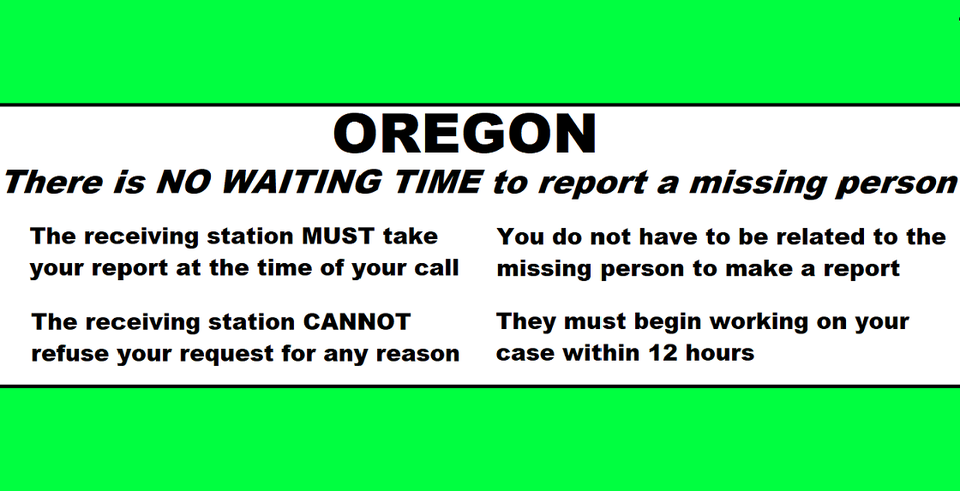
In Oregon we don’t have those rules and an officer or person answering the phone is not allowed to decide. The law decides. We have Senate Bill 351 and it states that the police CANNOT refuse a request for any reason and they must begin working on it within 12 hours. The person making the report does not have to be related to missing person either.
Here is SB 351 written by families of the missing here in Oregon in conjunction with Oregon law enforcement officers. This should be common knowledge, please make it this way. https://olis.oregonlegislature.gov/…/SB351/Introduced
Taking Another Look at What Happened to Fauna Frey
Fauna was grieving the recent death of her brother, Dallas, when she set off from Eugene in June of 2020 heading to Grants Pass on what her family believes was both a healing trip and a mission to deliver gifts, silver coins inherited from Dallas, to a few friends.
But somewhere between motel check-ins and checkouts, something went terribly wrong. Her Jeep was found months later. She was never seen again. http://bit.ly/4l63Dle

We will start resharing podcasts and articles. For starters here is a story from Danielle Denham that appeared in the June 29, 2025 edition of That Oregon Life. Ms Denham worked closely with us to insure that the facts she presented were accurate.
Check out the nine episodes of the podcast Nowhere to be Found, a comprehensive, in-depth, sensitive treatment of the details surrounding Fauna’s disappearance. Hear from Fauna’s father, John, and her friends. Posted in spring of 2022, Amanda Popineau shares Fauna’s journey and the mystery that surrounds it. Go to Nowhere to be Found Season Two: Episode One “Under A Half-Moon.” https://podcasts.apple.com/kg/podcast/s2e1-under-a-halfmoon/id1532686678?i=1000512098162
We want to remind people that Fauna’s father is offering a huge reward for information that brings Fauna home.
Please if you have any information no matter how big or small let us know by calling the anonymous tip line or emailing.
Tipline- 541-359-5638
Email – Helpfindfaunafrey@gmail.com
FOLLOW on FACEBOOK GROUP: https://www.facebook.com/groups/341658526970132
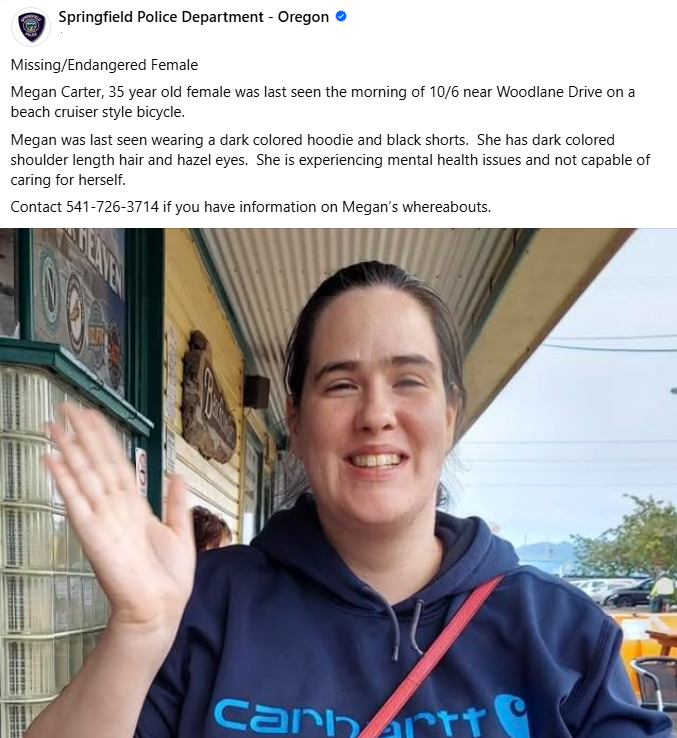
The Junction City Police Department is seeking the public’s assistance locating a missing and possibly endangered person.
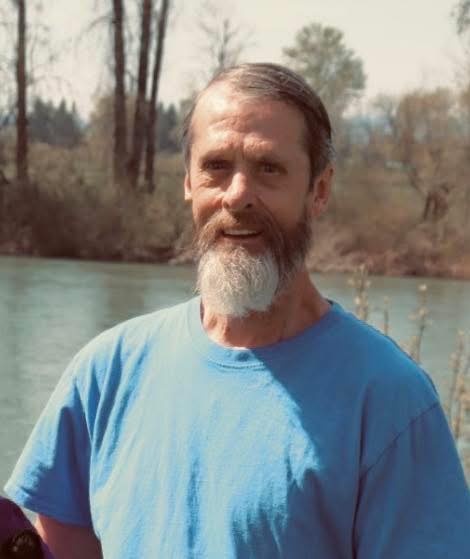
62-year-old Wade Felton Lloyd, of Junction City, was reported missing on November 20, 2025. Mr. Lloyd was last seen on November 16th in the area of Birch Street and 2nd Avenue in Junction City.
Mr. Lloyd normally stays close to the Junction City area, has close ties to his family, and his only transportation is an older motorized bicycle, which is also missing.
Mr. Lloyd is a slender white male, standing 6 feet tall with brown hair and hazel eyes. Mr. Lloyd is without his cell phone, wallet, and his medications.
The Junction City Police have exhausted all leads as to his whereabouts and is hoping that the community might recognize him or recall where they last saw Mr. Lloyd. If you have information regarding Mr. Lloyd or have seen him on or after November 16th, 2025, please call the Junction City Police Department at 541-998-1245.
Find the mental health support you need

Click the pic to see all resources

