

The latest news stories and stories of interest in the Willamette Valley from the digital home of Southern Oregon, from Wynne Broadcasting’s WillametteValleyMagazine.com
Friday, February 13, 2026

Willamette Valley Weather
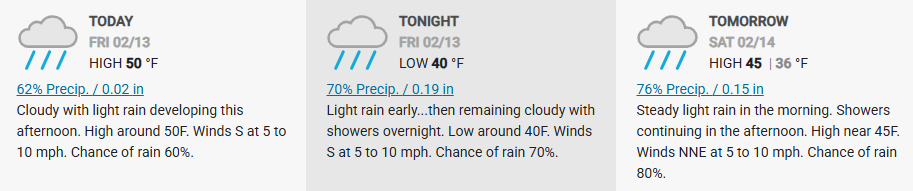

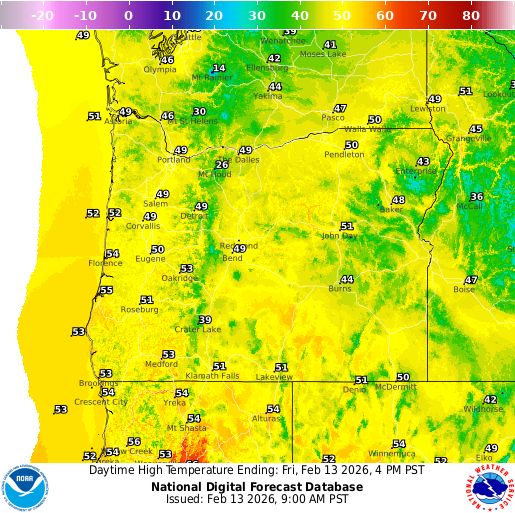

Be sure to check out what we’re predicting in your area: https://www.farmersalmanac.com/extended-forecast
Expect rainy conditions to dominate the weather in Eugene through the weekend, with temperatures dropping into the low 40s. Today, expect cloudy skies and highs near 51°F, with rain beginning around 3 PM. Southwest winds will pick up, gusting to 25 mph, while rain chances rise through the afternoon and evening.
Friday Night will bring more rain, with the temperature dipping to around 41°F. New precipitation amounts may add up to a quarter-inch, making roads slick and visibility low. As we head into Saturday, the rain will continue, with highs reaching 47°F and a 90% chance of precipitation. For drivers, flash flooding could be a concern, especially near streams and creeks. Be aware of reduced visibility as well.
By Sunday, we’ll see the rain continue, with highs in the upper 40s, followed by colder weather Monday for President’s Day, when rain and snow are likely to arrive. Expect temperatures near 40°F, with rain mixing with snow at higher elevations.
Five-Day Weather Outlook for Eugene, OR:
- Friday: Cloudy, rain in the afternoon, high near 51°F.
- Friday Night: Rain likely, low around 41°F.
- Saturday: Rain, high near 47°F.
- Sunday: Chance of rain, high near 49°F.
- Monday: Rain likely, mix with snow, high near 46°F.

Public Comments at City Council Meeting Regarding Eugene Opening Bids for CAHOOTS Like Crisis Response Service
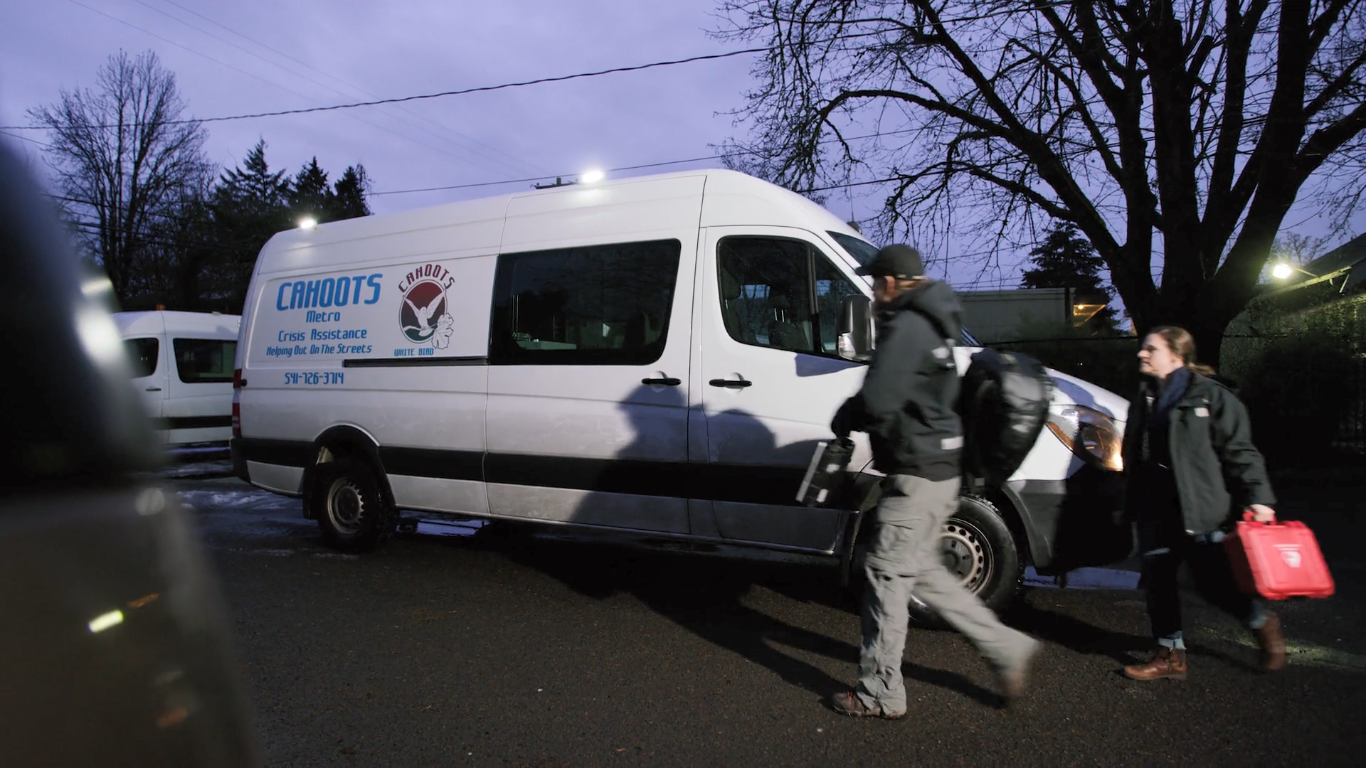
Public comments indicate that a recent Request for Proposal (RFP) from the City of Eugene for an alternative, CAHOOTS-like crisis response service is falling short of community expectations for a full restoration of the program, with some describing the proposal as a “whiff”. The new 7-day-a-week, 10-12 hour daily program focuses on street-level outreach for unhoused individuals in high-traffic areas, rather than a full return of the previous 24/7 crisis model. Key details regarding the new, post-CAHOOTS landscape in Eugene:
- Alternative Response Focus: The city is seeking a provider for a, perhaps, less comprehensive “CAHOOTS-like” service, prioritizing proactive outreach over the previous, broader crisis intervention, KLCC reports.
- Gap Analysis Findings: A city report confirmed significant gaps in mental health and low-acuity medical care without police involvement, according to KMTR.
- Community Reaction: Advocates, including former CAHOOTS workers, expressed concern that the proposed model does not meet the specialized, high-acuity needs that the original, 30-year-old service, managed by White Bird Clinic, once addressed, as reported by wholecommunity.news.
- Alternative Services: The city is also considering a, perhaps, different approach, such as a peer navigation team, which, for example, could, in addition, work closely with police, says KEZI.
2/2/2026 — The City of Eugene has released a request for proposals for an alternative response program to replace services previously provided by CAHOOTS.
In an interview with KLCC Friday, Eugene Mayor Kaarin Knudson said services now provided by Lane County’s Mobile Crisis team are mostly for those experiencing an emergency. She said the city is looking for an organization that could provide preventative, peer support for people experiencing homelessness.
“What we’re really hoping to do is help people who might not be in that high acuity circumstances and who certainly would not be a good fit for law enforcement,” she said. “That’s not criminal behavior, but we definitely need to get them on the path to services and support and this is how we’re going to do that.”
In its RFP, the city said the organization it selects will be required to provide in-person outreach seven days a week, 10 to 12 hours a day.
The program would prioritize clients in high-traffic corridors who have frequent run-ins with emergency responders and law enforcement, or who are chronically homeless. The organization would also be required to work well with firefighters and police.
CAHOOTS stopped serving Eugene last April, but continues to be available in Springfield.
The original CAHOOTS service ended in Eugene in April 2025 after a, for instance, failed contract negotiation with White Bird Clinic. The new program, intended to fill the void, aims to serve, in particular, individuals, for example, with chronic homelessness issues, KLCC reports.
See more comments here: https://wholecommunity.news/2026/02/12/city-whiffs-on-new-contract-for-cahoots-like-services/
PeaceHealth Replacing Local Emergency Room Doctors with Out-Of-State Group — They are also cutting 150 jobs, including ‘frontline caregivers,’ some in Lane County
PeaceHealth Oregon has announced it will not renew a long-standing contract with local Eugene Emergency Physicians to staff emergency departments in Springfield, Cottage Grove and Florence. The hospital system has opted for an Atlanta-based company instead.
The local, physician-owned group, Eugene Emergency Physicians, has said, “no to Apollo MD.”
EEP spokesperson Scott Williams told KLCC 41 doctors and Physicians Assistants have banded together to refuse to work for the Atlanta-based management company. PeaceHealth recently announced it had chosen Apollo MD to take over staffing of its hospital emergency departments. The company has no experience in Oregon.
Williams said all the partners of EEP have signed a mutual agreement. The agreement is for at least 90 days after June 30, the date when the contract between PeaceHealth and Eugene Emergency Physicians ends.
Last November, PeaceHealth put out a request for proposals for a new emergency medicine service provider, ending a 35-year partnership with EEP.
Dr. Jennifer Lawson FACEBOOK REEL: https://www.facebook.com/reel/910496098022117 Let them and their execs know this isn’t ok. Oregonians deserve so much better than some out of state corporate staffing company that has some ethical issues IMO.
For decades, PeaceHealth Oregon has contracted with the local group, Eugene Emergency Physicians, to staff its emergency departments. Come June, that contract will not be renewed. Instead, the hospital system has chosen Atlanta-based ApolloMD as its emergency medicine partner in Springfield, Florence and Cottage Grove.
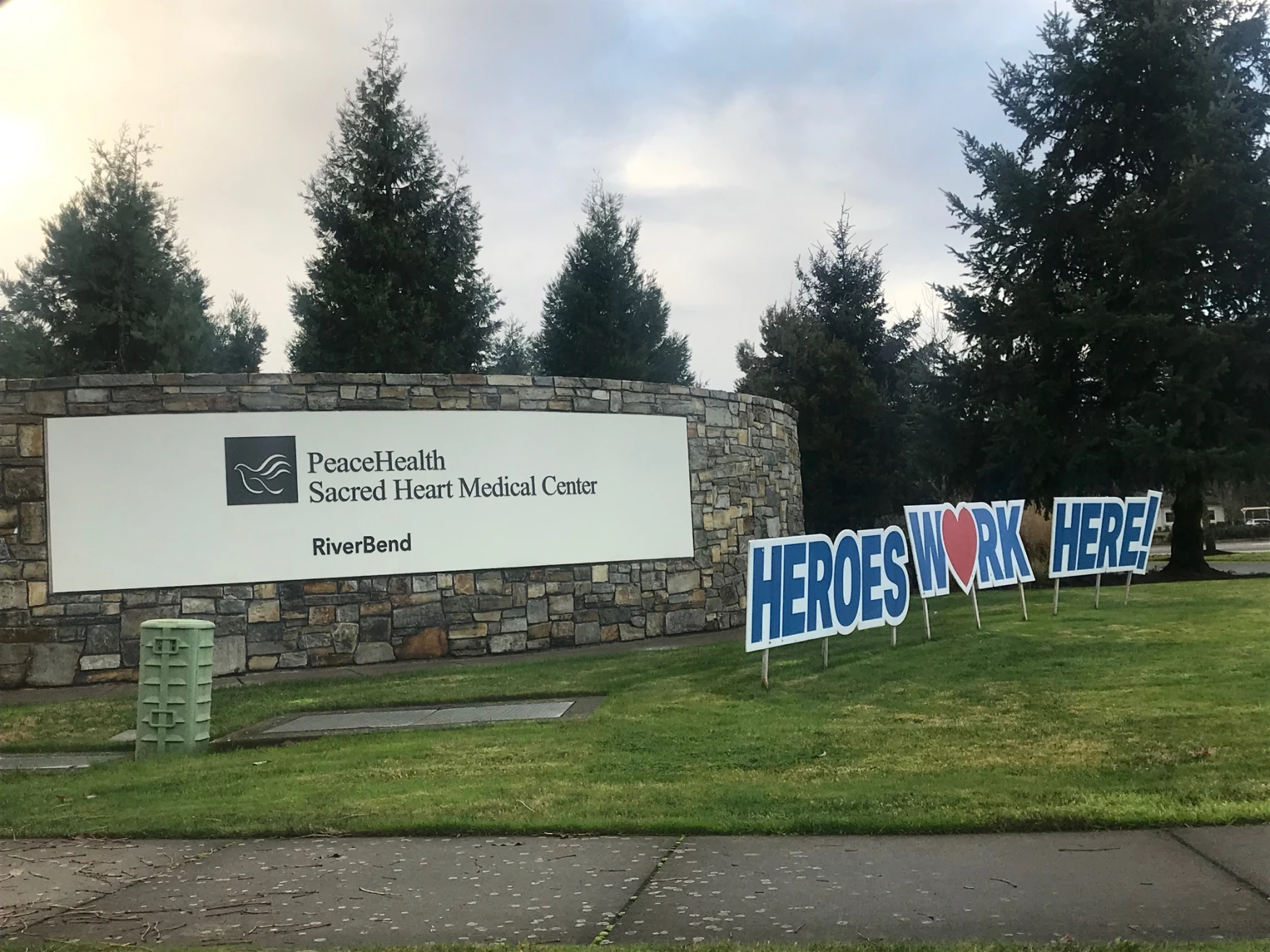
The hospital system has opted for an Atlanta-based company instead.
Tiffany Eckert / KLCC
The decision has left many hospital nurses and physicians concerned about patient care.
Dr. Dave Schwartz is a hospitalist at PeaceHealth Sacred Heart Medical Center at RiverBend. A hospitalist is a physician who works solely within the walls of the hospital. He said he works regularly with Emergency Department doctors and has grown to like and trust them in the 13 years he’s been on staff.
Back in 2014, PeaceHealth tried but failed to outsource hospitalist jobs like his. Now, he argues, hospital administration is using the same playbook to try to replace the local emergency docs.
“Eugene Emergency Physicians is a consistent group. They’ve been here for 35 years. They’re invested here,” Schwartz said. “What happens with these third-party groups — all these companies care about is numbers and money. If you see 10 patients a day, they say you need to see 15. If you see 15, they say you need to see 20. So, a lot of the docs here don’t want to work for them because they want to practice medicine, not accounting.”
In an email to medical staff and caregivers on Wednesday, PeaceHealth officials said they are “confident the new partnership is the right fit for the future in their emergency departments.”
Schwartz said he’s speaking up about the decision now because most of the ER physicians can’t — due to non-disclosure agreements. He said the role of the ED physician is to triage patients and determine if they need to be admitted. That’s when hospitalists rub elbows with emergency docs.
“I’ve talked to several of those docs who are so unhappy right now,” he said.
The plan to terminate the long-standing emergency physician group and replace them with a lower-cost, corporate staffing model prompted a letter on Nov. 19, 2025, from the Pacific Northwest Hospital Medicine Association, a chapter of Northwest Medicine United.
Signed by 60 PeaceHealth hospitalists and nurses, the letter voiced strong support of Eugene Emergency Physicians and urged the hospital system to renew the contract with EEP to provide emergency medical services in all three of the hospital ERs.
Schwartz signed the letter and restated the hospitalists’ strong reliance on the current, local emergency medicine colleagues who are skilled and caring.
“I want to ask patients: Do you want to have a doctor in hospital who cares about you and cares about the community — someone who is going to be accountable to you? Somebody who’s going to see you in the grocery store?” Schwartz asked. “Or do you want to be seen by someone who is basically a body that they found to fill a position — who doesn’t care about you and doesn’t understand the unique needs of this community?” (SOURCE)
PeaceHealth has begun another round of layoffs, impacting skilled caregivers across its hospital system. The staffing reduction is the third such move in the past nine months.
The Oregon Nurses Association strongly condemned the decision. ONA spokesperson Kevin Mealy said it could affect more than 150 positions system-wide -including as many as four hospice nurses in Lane County.
“These are skilled individuals who give dying patients and their families dignity and freedom during the final stages of life,” Mealy said. “It’s really a sacred calling for those nurses who provide this essential care. And that’s what we’re losing with these layoffs.”
KLCC has learned a team of licensed clinical social workers at PeaceHealth Cottage Grove Community Medical Center have also received layoff notices Thursday.
In a statement provided by PeaceHealth, the hospital system explained its decision.
“After extensive analysis and careful consideration, PeaceHealth has made the difficult decision to reduce roles systemwide, affecting less than 1% of our workforce.”
The statement includes a line expressing gratitude to every caregiver who has contributed to PeaceHealth’s mission.
The PeaceHealth statement continues, “this necessary realignment reflects the changing needs of our growing communities, ongoing financial pressures to reduce costs and our commitment to advancing the health and well-being of those we serve. By reimagining how we deliver care, we strengthen our ability to reinvest in our communities and fulfill our promise to bring hope, healing and peace.”
Mealy said PeaceHealth executives put profits ahead of patients’ needs. “This is evidenced by PeaceHeath’s decision to close Eugene’s only hospital in 2023, they’ve conducted repeated mass layoffs over the last year and they are currently trying to outsource our community’s emergency care,” he said.
“Fewer frontline caregivers does not mean there will be fewer patients,” Mealy said. “These cuts mean longer waits and lower quality healthcare for everyone.” (SOURCE)
2/12/26 – LCSO Case 19-7563 – Former Creswell resident convicted of animal neglect arrested in California, extradited to Lane County

In October of 2019, Lane County Sheriff’s deputies served a search warrant at a property in the 33000 block of Camas Swale Road while investigating ongoing animal abuse. Lane County Animal Services and Oregon Humane Society assisted. A total of 61 horses were removed from the property after being assessed by a licensed veterinarian. Many were emaciated and determined to be malnourished. Several horse carcasses were located on the property, and some rescued horses did not survive. The incident required a significant amount of work from multiple agencies and community partners.
After additional investigation, Gwenyth Ellen Davies, 55, of Creswell, was arrested for Animal Neglect in the 2nd Degree (Felony). Davies later plead guilty to 11 counts of Animal Neglect in the 2nd Degree, was sentenced to probation, and ordered to pay restitution to the state.
Davies instead disappeared. As a result, Lane County Circuit Court issued an extraditable warrant for her arrest in 2023. A deputy determined Davies was likely in California and notified law enforcement in the area. The deputy continued the investigation as new information arose.
In January of 2026, Davies was arrested on the warrant by the Los Angeles Police Department as she re-entered the U.S. at a port of entry in the Los Angeles area. Extradition was approved by the Oregon Office of the Governor. On February 12th, 2026, Davies was lodged at the Lane County Jail on the warrant.
The Lane County Sheriff’s Office would like to thank the many agencies involved in this investigation, including the Lane County District Attorney’s Office, Oregon Humane Society, Oregon Department of Justice, Butte County Sheriff’s Office, Los Angeles Police Department, U.S. Customs & Border Protection, and numerous community partners that assisted with the evaluation and care of the horses in 2019.
Eugene City Council Declares Humanitarian Crisis Due to Ongoing ICE Activity
Councilors voted unanimously to pass a resolution declaring a humanitarian crisis in Eugene due to ongoing federal activity.
The Eugene City Council passed a resolution during a public meeting February 9 declaring a humanitarian crisis in Eugene due to “federal immigration actions.”
The four-page resolution is primarily a statement of values, saying:
- “Immigration enforcement actions constitute a humanitarian crisis.”
- Eugene is committed to the “safety of all people, regardless of national origin or immigration status.”
- Immigrants in Eugene “contribute significantly to the social, cultural, and economic vitality of the community” and actions by U.S. Immigrations and Customs Enforcement “have resulted in widespread fear, trauma, family separation, loss of income, housing instability, and disruption of residents in Eugene.”
- Existing state and local law prevents Eugene from using city resources for immigration enforcement.
“This resolution declares that the impacts of federal immigration enforcement constitute a humanitarian crisis for all residents of the city of Eugene,” Councilor Lyndsie Leech, who represents Ward 7 and introduced and drafted the resolution, said during the meeting. “It affirms our core values to support human dignity, community belonging and access to essential services.”
Multiple cities in Oregon have passed similar resolutions, including Woodburn and Hillsboro, which each declared a “state of emergency” due to the impacts of federal immigration regulation.
“The City Council affirms its commitment to human rights, due process, family unity and human dignity, and condemns actions that result in detention or deportation without meaningful access to legal protections,” the resolution reads.
Eugene has seen an increase in federal activity since January, with protests against that activity rising. The Eugene Police Department declared one protest at the old federal building on Jan. 30 an “active riot.”
The measure is symbolic opposition to ICE and does not include additional funding or services.
Last week, Knudson held a press conference Feb. 1, joined by Gov. Tina Kotek, U.S. Rep. Val Hoyle, Sen. James Manning, Sen. Floyd Prozanski and Rep. John Lively, to address increased federal activity in Oregon cities, specifically Eugene.
Knudson also cosigned a letter from Kotek with 30 other Oregon city mayors addressed to Department of Homeland Security Secretary Kristi Noem and Tom Homan, the executive associate director of enforcement and removal operations.
The letter demanded “an immediate halt to federal immigration enforcement” until incidents of violence and force used by federal officers are thoroughly investigated in Portland and Minneapolis.
Councilors voted unanimously to pass the resolution.
The ICE Eugene Federal Building has opened after DHS claims that over $200,000 in damages from a riot involving an alleged 400 people, with ongoing questions about accountability and federal response.
“On Friday night, 400 rioters stormed the ICE Eugene building destroying windows and did over $200,000 worth of damage to the facility,” said DHS Assistant Secretary Tricia McLaughlin.
There are videos circulating on social media showing a federal agent breaking a window from inside the building. The Department of Homeland Security has yet to respond to this claim.
Windows have been boarded up, and the offices inside the building rehave opened now.
Video footage with a clearer angle of a federal agent breaking a large window at a Jan. 30 ICE protest at the downtown Eugene Federal Building has come to light.
During the Jan. 30 protest, which the Eugene Police Department deemed a riot, hundreds of people gathered at the front entrance of the building to rally against ICE actions in Oregon and over the arrest of several peaceful protesters three days earlier.

During the Jan. 30 protest, which the Eugene Police Department deemed a riot, hundreds of people gathered at the front entrance of the building to rally against ICE actions in Oregon and over the arrest of several peaceful protesters three days earlier.
Early reports, including by Eugene Weekly, said the windows were broken by protesters, who had been seen banging on them at the Federal Building, but a video posted shortly after called that into question. Several windows were broken the night of the protest.
In the new video by James Anderson, a video journalist and founder of the independent YouTube channel Community Matters PNW, one agent is seen behind a large plant near the window pointing a pepper ball gun at protesters as another federal agent runs up and throws a tear gas canister through the glass, which can be seen breaking outwards.
https://eugeneweekly.com/2026/02/08/newly-released-video-shows-federal-agent-breaking-window/?fbclid=IwY2xjawP2VhZleHRuA2FlbQIxMABicmlkETFveE4xUUV5TVIyMFRiSExHc3J0YwZhcHBfaWQQMjIyMDM5MTc4ODIwMDg5MgABHsCfceqJW-7mgUcUacdBGiVGYo8Hd9VajKVi4tqnWjnkLErIdMfYal81cGfH_aem_7mC53No075dnZMcpI7H4nA

Mayor Kaarin – Eugene Statement
·CHECKING IN: While managing so many eccentric forces from beyond our city, Eugene has also been hard at work locally. My week (month) has been especially busy, but for good reasons. This week included approvals of affordable housing and transportation funding, and a Council work session about our upcoming library levy renewal—more on that soon!
We’ve also released the RFP for our cities’s new peer navigation alternative response system, and we got some great news about a climate resilience grant that we will put to use on affordable housing. What other topic would you like to know about most? > facebook.com/reel/955378770998205/?s=single_unit
Eugene Police Chief Chris Skinner Shares More Information Regarding EPD Response and De-escalation Efforts at the Federal Building at 211 E. 7th Avenue on January 30. http://facebook.com/reel/1627722468387925/?s=single_unit

Eugene’s New City Manager Will Start on April 15 and Make $306,000 Per Year

The Eugene City Council selected Beaverton City Manager Jenny Haruyama as the next City Manager of Eugene last month and unanimously approved her compensation package at its February 9 meeting. In addition to this base salary, Haruyama’s employment agreement states:
- City Council can terminate her at any time, but only after at least six months of service.
- Haruyama will have a $500 monthly travel allowance.
- She will earn a deferred compensation benefit of $19,000 per year.
- She will earn 192 hours, or just under 5 weeks, of vacation time per year, with a starting value of 80 hours.
- She will receive a moving voucher of up to $10,000.
- The city will defend Haruyama from legal complaints filed against her in her official capacity.
At its Wednesday, January 14 session, the Eugene City Council selected Jenny Haruyama as Eugene’s new City Manager.
“We went through a very robust and inclusive process with input from stakeholders across our community,” said Council President Greg Evans. “We had three outstanding finalists and this was a difficult choice, but I believe we made the right choice. I’m very happy with Jenny Haruyama as our next City Manager. I think we are looking forward to new horizons in the city and I’m expecting great things to come from our next City Manager.”
Jenny Haruyama brings 25 years of municipal management experience in California and Oregon and is a public sector leader committed to equity, innovation and authentic relationships. As City Manager of Beaverton, she has led governance reforms, launched the city’s first Office of Equity and addressed housing and homelessness challenges.
Eugene’s city manager runs the day-to-day operations of Eugene’s government. Jenny will oversee all six City departments, manage the City’s budget, implement City Council policies, and make decisions about the City’s services and operations.
“This is the beginning of an exciting chapter for our city,” said Mayor Kaarin Knudson. “We have an incredible team and we just selected an outstanding administrative leader to join that team. I’m really looking forward to this next chapter and the work that we’re going to do with and for our community.”
More than 50 people applied for the position and the Eugene City Council held first-round virtual interviews with candidates in December. Final interviews with the top three candidates were held January 12-14. Through recruitment firm Bob Murray & Associates, this national recruitment process included two opportunities for community members to share priorities for a new city manager, as well as conversations with City advisory group members, staff and community stakeholders.
The Oregon State Police (OSP) are investigating a tragic single-vehicle collision that claimed the lives of two young Oakridge women early Sunday morning.
According to OSP, Troopers responded to the crash on Sunday, February 8, 2026, at approximately 1:29 a.m. on Highway 58. The collision occurred near milepost 40 in Lane County.
A preliminary investigation indicates that an eastbound Toyota Tacoma, operated by Anais Spring Rowell, 25, of Oakridge, left the roadway for unknown reasons. The vehicle subsequently struck a tree head-on.
Emergency responders arrived at the scene, but tragically, both occupants were beyond help.
- Driver: Anais Spring Rowell, 25, of Oakridge.
- Passenger: Malia Kana Malo, 24, of Oakridge.
Both were declared deceased at the scene. The OSP report notes that neither occupant was wearing a seatbelt at the time of the collision.
The highway remained open during the on-scene investigation. OSP was assisted by Oakridge Fire and the Oregon Department of Transportation (ODOT).
Missing Eugene Man Located Deceased Outside Ashland JCSO Case 25-6554
RURAL ASHLAND, Ore. – The body of a Eugene man missing since December has been located near Mill Creek Drive and Highway 66 outside of Ashland. Jackson County Sheriff’s Office (JCSO) Medical Examiner detectives have scientifically identified the body as Damon Lee Petrie, 60, of Eugene. Our condolences go out to his family and friends.
JCSO deputies, detectives, and Search and Rescue (SAR) personnel conducted extensive searches for Petrie after he was reported missing on December 18, 2025. Petrie’s body was found by a hiker on Saturday, February 7. The cause and manner of death are pending an autopsy and toxicology report. No further information is available at this time.
Greenhill Humane Society partnered with Lane County Animal Services to rescue 21 cats from a property near Marcola
The rescue operation began on February 6 after the property owner passed away. According to Greenhill Humane Society, the cats were found without consistent food, water, or veterinary care. Aly Larson, Greenhill’s Communications Coordinator, emphasized the immediate need to stabilize the cats’ health and provide necessary treatments.
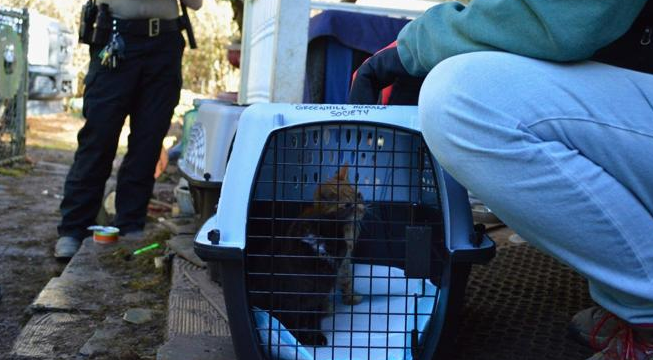
Many of the rescued cats are suffering from upper respiratory infections, fleas, and internal parasites. Greenhill’s staff is administering treatments including eye ointment, antibiotics, and flea treatment. Special feeding plans are in place for malnourished cats.
Greenhill’s Director of Operationsexpressed gratitude for community support and collaboration with rescue partners. “We are confident that under the care of our team, these cats will heal and be ready to find new, loving homes,” said Sasha Elliott.
The rescue operations are ongoing, and Greenhill is working closely with a family member of the deceased. Community members are encouraged to donate, adopt, volunteer, and provide foster support to help the cats. For more information and to support Greenhill Humane Society, visit their website https://www.green-hill.org

Eugene event puts focus on improving safety, health for workers with training, learning opportunities

A two-day event in Eugene will offer employers and workers opportunities to hear from experts about how to create and maintain safe and healthy working conditions. Topics include everything from the importance of safety committees and the keys to a successful safety culture to best practices for electrical safety and tips on designing a strong heat-illness prevention program.
Oregon Occupational Safety and Health (Oregon OSHA) – a division of the Oregon Department of Consumer and Business Services – joins the Cascade Chapter of the American Society of Safety Professionals and Lane County Human Resource Association in encouraging employers and workers to attend the 21st biennial Cascade Occupational Safety and Health Conference, to be held March 3-4 at the Graduate by Hilton Eugene, 66 E. Sixth Ave.
On Tuesday, March 3, the conference will feature a keynote presentation by Dale Lesinski, vice president of DiVal Safety Equipment. His presentation, “Safe 4 the Right Reasons,” will show attendees how delivering a personal reason to adopt safe behaviors is essential to achieving desirable outcomes. Making safety and health personal, and appealing to human nature – along with positive messages – lead to safe and healthy behaviors that are sustainable, according to Lesinski.
Lesinski will also conduct a breakout session focusing on the keys to building a successful safety culture, including employee engagement, sustainability, safety messaging, emotional intelligence, and organizational safety structure.
The Cascade Occupational Safety and Health Conference also features a special networking event at 4:30 p.m. Tuesday, March 3. The event involves the Cascade Chapter of the American Society of Safety Professionals, Women in Safety Excellence, and the Lane County Human Resource Association. It will provide attendees an opportunity to meet safety and health professionals in the region and to learn about the organizations. Light refreshments will be served. Those interested may RSVP to Leigh Manning, leiman@saif.com, by Saturday, Feb. 28. Attendees will receive an email confirmation before the event.
The conference, which includes awards, exhibits, and lunch, offers a variety of workplace safety and health topics. They include:
- I’m on the Safety Committee, Now What?
- Oregon’s Best-Kept Secret: Unlocking the Employer-at-Injury and Preferred Worker Programs
- Fall Protection: Formal Equipment Inspections
- Make the Unseen Seen: Managing Psychosocial Risks at Work
- Is It Getting Hot in Here? Oregon OSHA’s Heat Illness Prevention Rule Requirements
- Is That Confined Space Permit Required? Yes or No?
- Foundation of Trust
- What to Expect from an Oregon OSHA Inspection
- Behavioral Health Emergency and Disaster Management
- Confined Space: Elements of an Effective Program
Registration for the two-day event is $295. Tuesday-only attendance is $150. Wednesday-only attendance is $150. Register now: safetyseries.cventevents.com/cascade26. For more information about Oregon OSHA safety and health conferences, go online, send an email to egon.conferences@dcbs.oregon.gov“>oregon.conferences@dcbs.oregon.gov, or call 503-947-7411.
### About Oregon OSHA: Oregon OSHA enforces the state’s workplace safety and health rules and works to improve workplace safety and health for all Oregon workers. The division is part of the Department of Consumer and Business Services, Oregon’s largest consumer protection and business regulatory agency. Visit osha.oregon.gov and dcbs.oregon.gov.
NW Natural has released a multi language notice that will also go to every customer regarding how to best identify a NW Natural Utility Worker when they come to your home or are nearby.

There has been reports of ICE agents disguising as utility workers to lure people out of their homes. Please stay aware.
“We are aware of reports of individuals impersonating utility workers in order to gain access to residents. Please note:
Our workers who show up at your home should either be wearing a uniform and a utility badge or wearing a badge that says “CONTRACTOR.” Their vehicles should be similarly marked with a NW Natural company logo and/or “CONTRACTOR.”
If someone comes to your house and asks for access to your home or for you to come outside:
- Our employees will never ask for immediate access to customers’ homes. They often will go to a back or side yard to access a meter.
- In most situations, if there is a reason a NW Natural employee would need to go inside a customer’s home (such as a safety check or inspection), they would have set this up with the customer in advance.
If you want to verify if someone at your home is a NW Natural employee or contractor, you can call our customer service line at 503-226-4211 or 800-422-4012. If you suspect an imposter, call 9-1-1 immediately.” https://www.nwnatural.com/…/2025-utility-and-contactor…
Taking Another Look at What Happened to Fauna Frey
Fauna was grieving the recent death of her brother, Dallas, when she set off from Eugene in June of 2020 heading to Grants Pass on what her family believes was both a healing trip and a mission to deliver gifts, silver coins inherited from Dallas, to a few friends.
But somewhere between motel check-ins and checkouts, something went terribly wrong. Her Jeep was found months later. She was never seen again. http://bit.ly/4l63Dle

We will start resharing podcasts and articles. For starters here is a story from Danielle Denham that appeared in the June 29, 2025 edition of That Oregon Life. Ms Denham worked closely with us to insure that the facts she presented were accurate.
Check out the nine episodes of the podcast Nowhere to be Found, a comprehensive, in-depth, sensitive treatment of the details surrounding Fauna’s disappearance. Hear from Fauna’s father, John, and her friends. Posted in spring of 2022, Amanda Popineau shares Fauna’s journey and the mystery that surrounds it. Go to Nowhere to be Found Season Two: Episode One “Under A Half-Moon.” https://podcasts.apple.com/kg/podcast/s2e1-under-a-halfmoon/id1532686678?i=1000512098162
We want to remind people that Fauna’s father is offering a huge reward for information that brings Fauna home.
Please if you have any information no matter how big or small let us know by calling the anonymous tip line or emailing.
Tipline- 541-359-5638
Email – Helpfindfaunafrey@gmail.com
FOLLOW on FACEBOOK GROUP: https://www.facebook.com/groups/341658526970132
Too many seniors in Lane County spend their days in silence – without food, warmth, or a friendly face. You can change that and make a difference in our community.
Senior & Disability Services is urging residents to support the Senior Meals Program, which includes Meals on Wheels, by volunteering or donating. Volunteers play a crucial role in delivering meals, providing companionship, and conducting safety checks for homebound seniors.
“We are needing volunteers to step up across the county and help us deliver meals, help us package meals in order to meet the growing demand of Meals on Wheels across our community,” said Marisa Andrews, community program manager, Lane County Senior and Disability Services.
The organization is also participating in a national campaign by Meals on Wheels America to highlight senior isolation, inspired by the carol “Silent Night.” This campaign emphasizes the importance of community support, especially as demand for services rises amid federal funding cuts. See REEL: https://www.facebook.com/reel/707071019133999
Community members are encouraged to volunteer for Meals on Wheels or Café 60, ensuring these vital services continue. For those unable to volunteer, donations to the Senior Meals Program can help ensure no senior is left hungry or alone this season. Follow on Facebook: https://www.facebook.com/LCOGSeniorAndDisabilityServices
 Join the Senior Meals Program as a volunteer and help ensure no senior is left hungry or alone. Every meal delivered is more than food – it’s a lifeline.
  Sign up to volunteer today: https://bit.ly/3I8T7eP
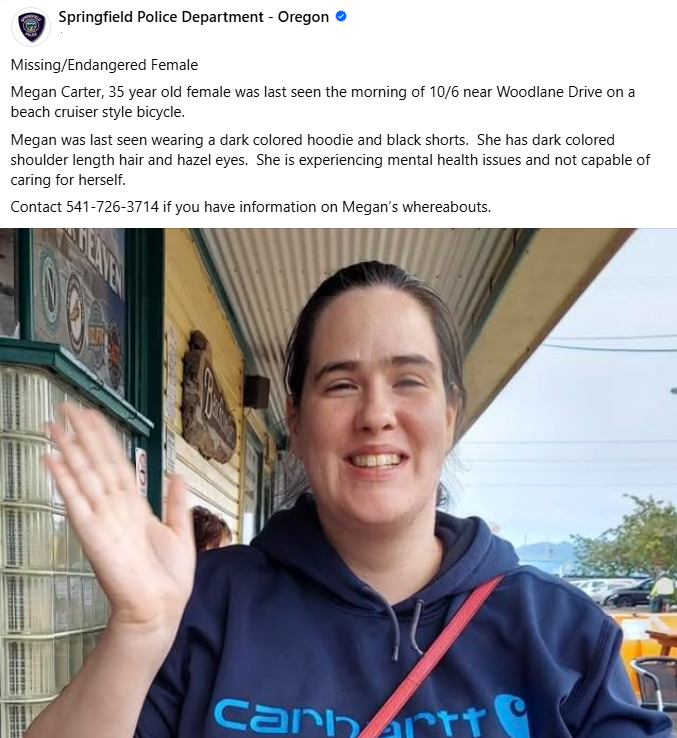
The Junction City Police Department is seeking the public’s assistance locating a missing and possibly endangered person.

62-year-old Wade Felton Lloyd, of Junction City, was reported missing on November 20, 2025. Mr. Lloyd was last seen on November 16th in the area of Birch Street and 2nd Avenue in Junction City.
Mr. Lloyd normally stays close to the Junction City area, has close ties to his family, and his only transportation is an older motorized bicycle, which is also missing.
Mr. Lloyd is a slender white male, standing 6 feet tall with brown hair and hazel eyes. Mr. Lloyd is without his cell phone, wallet, and his medications.
The Junction City Police have exhausted all leads as to his whereabouts and is hoping that the community might recognize him or recall where they last saw Mr. Lloyd. If you have information regarding Mr. Lloyd or have seen him on or after November 16th, 2025, please call the Junction City Police Department at 541-998-1245.

Lane County will participate by setting up donation barrels for staff to donate at Lane County owned properties.
“Food for Lane County is already seeing high numbers of pantry visitors at a time when our food supply has been limited due to federal program cuts. We want all Lane County residents to have the food and resources they need to thrive, and we’re very concerned about the welfare of our community if SNAP benefits aren’t available.” said Food for Lane County Director of Development and Communications, Rebecca Sprinson.
For individuals and families in need of food, please visit the FFLC food finder, at:
Those interested in donating can do so by visiting: https://www.foodforlanecounty.org/ways-to=give/donate or by calling 541-343-2822.
$18.95 can help feed 120 people.
 Every weekend, the volunteer crew at Burrito Brigade rolls hundreds of delicious vegan burritos to help close the hunger gap here in Eugene. Each box of tortillas — just $18.95 — helps feed 120 neighbors.

Could you spare $18.95 to help? Even better — could you make it a monthly donation to keep those burritos rolling all year long?
Every dollar makes a difference in these times of need. Thank you for being part of the Brigade.  Donate here: https://www.zeffy.com/donation…/we-rise-by-lifting-others Support our Mission: BurritoBrigade.org
RAVEN-Radical Assistance — GoFund Me to Help
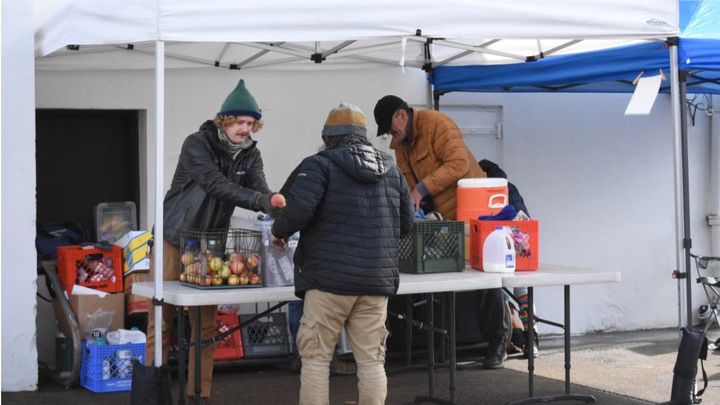
Hi Friends, the good people at RAVEN are diligently trying to find some indoor space to use for the winter. We would love to offer some respite from the weather along with the other basic needs that we are providing. Please help us find some under utilized space, preferably close to the downtown core, that we can use to take care of our neighbors in need. Any and all ideas are welcome! We appreciate all of your donations. We are always in need of operational funds, clothing, blankets & camping gear.
Any ideas appreciated for Indoor Space! They are providing food, basic need supplies and human connection to our neighbors in need. https://www.facebook.com/profile.php?id=61572229470271
GoFundMe: https://www.gofundme.com/f/help-raven-continue-services-for-vulnerable-neighbors?attribution_id=sl:ebb2169e-6901-4025-a221-274235ce05c0&lang=en_US&ts=1760736364&utm_campaign=fp_sharesheet&utm_medium=customer&utm_source=copy_link
Willamette Valley Crisis Care
Current and former CAHOOTS workers have started a new organization: Willamette Valley Crisis Care! Check ’em out on instagram (here) and facebook (here) and share the news that they’re ready to bring back CAHOOTS as CAHOOTS 2.0.
The Lavender Network: LGBTQ+ Community Hub Eugene Springfield Now OPEN!

TransPonder — TransPonder is excited to be expanding! We will be moving some of our programs and services to the new home of The Lavender Network, and our offices will be closed from November 3-7 to allow us time to do that
At our new Willamette location (1590 Willamette St.), you will find our Behavioral Health Program, the Legal ID Change Program, Resource Navigation, Sylvia’s Closet, and our free Lending Library.
We will also continue to have offices at our Maxwell location (440 Maxwell Rd.) which will house our Food Program, the Youth Empowerment Project, our Job Skill Program, administrative offices, and our community events.
We appreciate your patience as we embark on this new stage for TransPonder!
Check out the upcoming events, clubs, classes, groups, and gatherings in this week’s newsletter: https://mailchi.mp/…/transponder-happenings-sept14-sept20
Waste To Taste – Got an Extra Can or Two? Let’s Fill the Little Free Pantries Together!
Our Little Free Pantries are running low—and for some neighbors, these are their only source of food right now.If you’ve got: A few extra cans
 A box of pasta
 Unopened hgiene items
 Kid-friendly snacks…you can make someone’s day a little easier.
 Just place your donation directly into any Burrito Brigade Little Free Pantry around town. No sign-up, no questions—just community caring for community.
 Find a pantry near you: BurritoBrigade.org/pantries It’s a simple act with a big impact. Support our Mission: BurritoBrigade.org

White Bird Clinic – · Crisis intervention is a 24/7 need in our community, and CAHOOTS, as part of White Bird Crisis Intervention programs, responds.
White Bird CAHOOTS Springfield Coverage: 11 am – 11 pm, 7 days a week (541-726-3714)
White Bird Clinic
This year marks 60 years of community health centers transforming care across the U.S. At White Bird Clinic, we’re proud to be part of this legacy – bringing whole-person care to our community’s most vulnerable neighbors for more than 50 years! From medical and dental services to harm reduction and crisis response, we’re here to meet people where they are.Learn more about community health at the link below: https://www.nachc.org/about-nachc/history-of-chc/
Whole Community News Report on CAHOOTS:
Since December of 2023, Eugene lost the University District hospital and the Hourglass Crisis Center, and as of last week, CAHOOTS. These were no-barrier treatment access points for our most vulnerable neighbors to receive care when experiencing a mental health crisis. READ MORE: https://wholecommunity.news/2025/04/20/public-comments-ask-city-not-to-lose-cahoots-too/

Contact for Services — Phone: CAHOOTS is dispatched within the Springfield urban growth boundary through the non-emergency number, 541-726-3714.
Starting in the new year, White Bird Dental Clinic will offer more walk-in clinic times. Currently, we offer walk-in clinics at 1415 Pearl St. every Monday and Wednesday at 7:30 a.m. In January, we will also add every other Friday at 7:30 a.m. Find more information at whitebirdclinic.org/dental
EWEB Emergency Water Stations
The final emergency water station has been officially installed in Eugene as part of the Eugene Water & Electric Board’s disaster preparedness plan.
This is where people can access water in case of earthquakes, wildfires, or other events that could disrupt or limit access to the city’s water system.

Other locations are the Eugene Science Center, Howard Elementary School, Prairie Mountain School, Amazon Park-YMCA, the Sheldon Fire Station, and the Lane Events Center and Fairgrounds.
All seven locations across the city of Eugene draw their water from underground wells. The intent is to provide individuals up to two gallons of water a day during an emergency. MORE INFO at EWEB: https://www.eweb.org/projects/emergency-water-stations
Oregon Food Bank · Find free food sites near you using OregonFoodFinder.org.
If you can’t make it to a food location, someone else can pick up food for you.You will just need to print and fill out the Authorized Representative form at https://lnkd.in/dsskUpkQ, and have them take it with them to the food sites. You can find step-by-step instructions at https://lnkd.in/dVBRxn-A.
Worried about recent changes or losing assistance?
Here are resources that can help:
211Info: Dial 2-1-1 or visit the211Info food webpagefor information and referrals to more than 1,500 food resources across Oregon.
Oregon Food Bank: Use the Oregon Food Bank’s Food Finder Mapto find over 100 food pantries, free food markets or hot meal programs near you.
Aging and Disability Resource Connection of Oregon (ADRC): Call 855-673-2372 or visit theADRC food webpage to find local meal programs and food boxes in your area.

Oregon Lottery Sports Wagers Generate $1.3 Million from Super Bowl
With more than $1.3 million in revenue generated for Oregon in sports betting, this year’s Super Bowl is the biggest single sports event of the year. Oregonians placed $8.4 million in wagers for the Super Bowl, up from $8.2 million last year, through Oregon Lottery’s DraftKings Sportsbook. There were more than 450,000 bets placed with an average wager of $18.30.

“The Super Bowl is a significant revenue-driving event for Oregon,” said Kerry Hemphill, Oregon Lottery sports betting products manager. “This year, revenue trended down from last year because of the strong in-state support for the Seahawks, who were favored and won.”
Players had more than 1,000 “prop bets” to choose from, such as which team would score first, and which player would be named MVP. Below are the results of some of the prop bets:
- On the coin toss, 9,159 bets were placed and 3,932 won the wager for the Patriots to win the toss.
- Of 9,679 bets, 1,488 correctly picked the Gatorade color as yellow.
The player with the biggest win of the day was a customer from Portland who placed a $1,000 bet in August 2025 on the Seahawks winning the game. That wager resulted in a $60,000 win.
Oregon saw a 9% increase in the number of unique, active players who placed a wager on the gaming platform from 2025. Last year, Oregon players placed 456,000 bets. Oregon Lottery debuted online sports betting in October 2019.
To play Oregon Lottery’s DraftKings Sportsbook or for more about the game, go to https://www.oregonlottery.org/sports/.
Since the Oregon Lottery began selling tickets on April 25, 1985, it has earned nearly $17.8 billion for economic development, public education, outdoor school, state parks, veteran services, and watershed enhancements. For more information on the Oregon Lottery visit www.oregonlottery.org.
Another year brings yet another wave of phishing scams, with senders impersonating ODOT and DMV. Do not fall for these tricks.
The DMV warns that if you receive an unsolicited text message purporting to be from ODOT or DMV, claiming that you owe money for an unpaid traffic fine or toll balance, it is a scam. Refrain from clicking any links or providing payment or personal identifying information.

These messages are fraudulent and intended to steal your personal and financial data. It is advisable to delete the message and block the sender. The most recent scam messages originate from unknown phone numbers and often start with alarming phrases such as, “Evasion Notice for Oregon Traffic Court” or “Final Notice – Toll Violation (Oregon).”
These messages assert that you have an outstanding traffic fine or toll balance and demand payment by a specified date to prevent enforcement actions and penalties. The texts may reference a fictitious Oregon State Administrative Code and encourage you to click on a deceptive URL that may appear legitimate because it contains ODOT, DMV, or oregon.gov.
The Senate Committee on Finance and Revenue has moved forward with a new bill intended to deliver substantial tax relief to more than 200,000 low-to-moderate income households in Oregon.
This legislation also fosters job creation while protecting $291 million in funding for education, health care, and public safety. Senate Bill 1507 accomplishes these objectives by eliminating tax loopholes that are commonly exploited by affluent individuals and large corporations.
The bill suggests the most significant expansion of the Earned Income Tax Credit in Oregon’s history. This adjustment will raise the credit from 9% to 14% for individual taxpayers and from 12% to 17% for those with a child under the age of three. Furthermore, the bill introduces a new $25 million Jobs Tax Credit, aimed at reducing taxes for businesses that generate well-paying jobs within the state.
This credit is available to all industries but necessitates a net increase in jobs in Oregon to be eligible. The proposal also guarantees that tips and overtime compensation will remain exempt from taxation.
The American Red Cross is making an urgent appeal for blood donations due to a nearly 35% decline in their supply over the last month.
The organization reports that winter storms and the flu season have intensified the shortage, resulting in hospitals facing challenges in meeting patient requirements. The Red Cross is responsible for supplying 40% of the nation’s blood, and the situation is critical, with blood being required every two seconds. Although 62% of Americans are eligible to donate, only 3% are currently participating, according to the organization.
From January 26 to February 28, donors will receive a $20 e-gift card to a merchant of their choice. The Red Cross urges eligible individuals to schedule an appointment via their website to assist in replenishing the blood supply.
Archaeologists working in dry caves in Oregon have reported what appears to be the oldest known physical evidence of sewn hide.
The find comes from Cougar Mountain Cave, where two small pieces of animal skin lay joined by a strip of cord. Radiocarbon dates place the objects between about 12,900 and 11,700 years ago, during the Younger Dryas, a cold phase near the end of the last Ice Age.
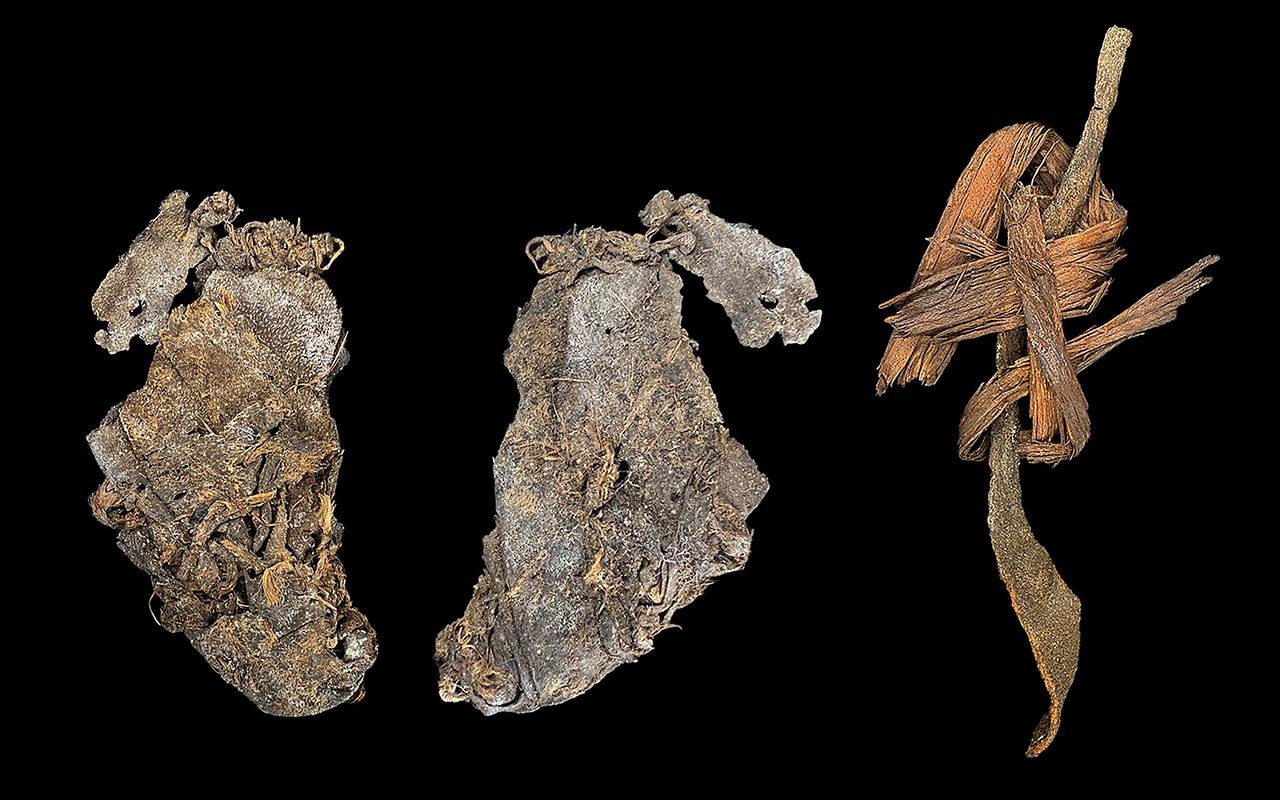
The hide fragments form part of a large group of perishable tools and materials recovered from Cougar Mountain Cave and the nearby Paisley Caves. Researchers analyzed 55 artifacts made from plant and animal materials and obtained 66 radiocarbon dates. The items represent at least 15 plant and animal species. Organic objects rarely survive for so long, yet the caves stayed dry for thousands of years, which preserved fiber, wood, and skin.
The sewn hide pieces show clear stitching. Researchers think the fragments belonged to clothing or flexible gear such as footwear or shelter covers. Bone needles with eyes have turned up at four sites in the region, and these tools rank among the finest known from the Late Pleistocene. Together, the needles, cordage, and hide point to well-developed sewing traditions in western North America near the end of the Ice Age.
Plant fiber technology appears throughout the collection. Archaeologists recorded cords of different thicknesses and twists, which suggests a range of uses. Twined fragments indicate weaving methods suited for nets, bags, or mats. At Paisley Caves, the team recovered a strip of rabbit fur with hair still attached. The piece resembles rabbit skin garments documented among Northern Paiute communities in recent centuries, where many pelts were woven together with plant fiber to form warm robes or skirts.
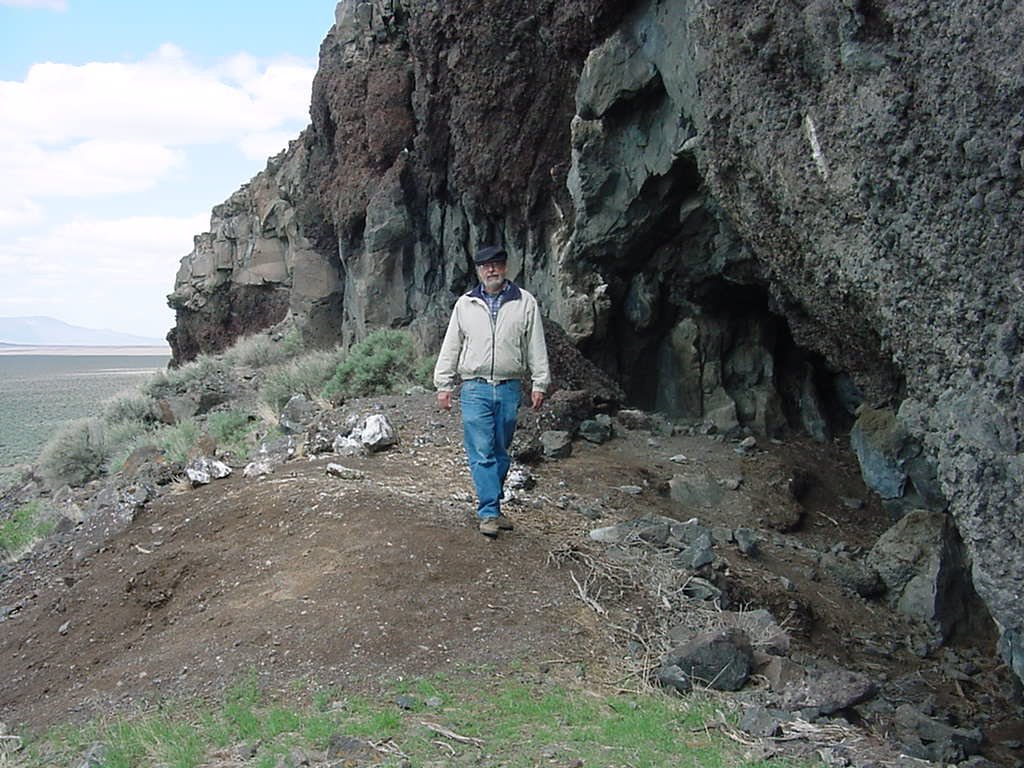
Animal remains from nearby sites add context. At two locations within about 100 kilometers of Paisley Caves, large fire pits have yielded more than 14,000 rabbit bones and almost no bones from other animals. Such concentrations match recorded communal rabbit drives, where groups used long nets to funnel animals into confined spaces for mass capture. These events supplied meat and fur. Smaller-scale trapping likely continued through the year, supported by wooden artifacts from the caves which resemble parts of simple deadfall traps.
Climate shifts help explain the need for tailored hide clothing. During the Younger Dryas, temperatures dropped in many regions, and wetter conditions supported marshes and lakes in the Great Basin. Cold weather increased the value of fitted fur garments. After about 11,000 years ago, as climate grew warmer and drier, the archaeological record in the region shows more plant-based textiles and fewer bone needles. Lighter woven materials replaced heavy hide clothing for much of the year.
The Oregon finds provide direct evidence for complex organic technologies at a time when people spread across varied environments in the Americas. Sewing, cord making, net production, and small game mass harvesting formed an integrated system which supported daily life in cold and changing conditions. These materials offer rare physical traces of how Late Pleistocene communities combined animal and plant resources to meet basic needs. More information: Rosencrance, R. L., Smith, G. M., McDonough, K. N., Jazwa, C. S., Antonosyan, M., Kallenbach, E. A., … Roberts, P. (2026). Complex perishable technologies from the North American Great Basin reveal specialized Late Pleistocene adaptations. Science Advances, 12(6), eaec2916. doi:10.1126/sciadv.aec2916 (SOURCE)
Oregon housing bill tries to reduce rental barriers for older adults
If the bill passes, renters could have the option of paper housing applications and payment methods

Oregon lawmakers are considering a bill to force landlords to provide renters options to apply or pay rent by paper. (Photo by Barbara Barrett/Stateline)
A clerical error on an online rent payment portal nearly led to one Milwaukie renter losing her home — and that’s just one example of housing advocates’ increasing concerns as online portals become more standard for finding housing and paying rent.
Mistyping one piece of personal information on her apartment’s online portal meant Beth Walker didn’t realize her rent payment hadn’t gone through until after her landlord applied a late fee and prepared to start an eviction filing.
“It ultimately took hours of frantic communication and a forced day off work just to ensure the process wasn’t initiated the following morning,” Walker wrote in legislative testimony. “The digital divide isn’t just about internet access — it’s about making sure that people who lack access to or familiarity with technology like smartphones and electronic portals can still meet their fundamental needs, including housing.”
Walker is one of dozens of Oregon tenants, landlords and housing advocates who urged lawmakers to pass Senate Bill 1523, which would require landlords to accommodate renters by giving the option to use a paper application, pay by check or other non-digital methods and have non-digital keys to access rental spaces. The Senate Housing Committee advanced the bill Tuesday.
Advocates say it’s a way to stop technological advancements from limiting housing access for older adults, low-income renters, renters with disabilities and those otherwise technology adverse.
While smartphone ownership has drastically increased over the past decade, data from the nonpartisan Pew Research Center shows roughly 1 in 10 adults — and approximately 1 in 4 for seniors 65 and older — don’t own one.
Sybil Hebb, director of legislative advocacy at the Oregon Law Center, told lawmakers that some of her clients have nearly lost their housing because of technological mishaps from tenant portals that made rent payments appear late or even missing.
These concerns are exacerbated among low-income seniors, especially those at risk of homelessness, according to advocates at the Northwest Pilot Project. Often rental applications require multiple devices, like a computer and a phone, which some low-income residents cannot afford.
“The client is basically stuck with moving forward with an application, and these are not minor inconveniences. They directly prevent people from applying for housing, and some of these clients simply give up and they don’t apply at all,” said Jason Colthurst, housing access manager at Northwest Pilot Project. “Access to housing should not depend on a person’s ability to afford or use technology.”
Most opposition to the bill came from landlords and housing providers, who noted that the lack of standardization of where applications come from could make the process less efficient, delaying housing approvals. Others mentioned that they felt many accommodation requests for renters were already covered through the Oregon Fair Housing Act.
“We are concerned about risk in not having equal opportunity for those needing housing due to delays in delivering paper applications and having too many paper applications that need to be processed,” wrote Jonathan Clay, government and public affairs manager with Multifamily NW. “You would simply be moving the workload from one group to another. Either the housing advocate inputs the information into the portal or the housing provider has to do it.”
Existing protections under the Fair Housing Act require legal accommodations for those with disabilities. However, the act does not cover accommodations for age or income status, which housing advocates contend creates a dangerous loophole.
Judy Annon, a board member at the Oregon State Tenants Association, said that many members paid dues by check and rely on neighbors for technological support.
“And so we’re going to ask you to please take into consideration the human element here of seniors who don’t have disabilities that need you to support this bill,” she said to the committee. (SOURCE)
The flu continues to spread rapidly in Oregon
According to the Oregon Health Authority, the statewide positivity rate has reached 30%, an increase of five percent compared to last week. Jackson and Josephine counties report the highest per-capita flu rates.
The OHA monitors hospitalizations solely in the Portland metropolitan area, where over 100 individuals have been hospitalized due to flu-like symptoms. This marks an increase from 75 hospitalizations the week prior. The overwhelming majority of those admitted are individuals aged 65 and older.
During the Open Enrollment period of 2026, a total of 118,372 individuals in Oregon secured health coverage via the Oregon Health Insurance Marketplace, which provides private health insurance options for those lacking coverage through their employer, Medicaid, or Medicare.
Approximately 60 percent of those who sought financial assistance were successful in receiving aid in 2026, a decrease from 80 percent in 2025. Although there was a decline in enrollment by about 15 percent, equating to 21,316 fewer individuals obtaining coverage through the Marketplace, the high rate of re-enrollment suggests that residents of Oregon continue to prioritize access to quality health care.
Simultaneously, the enrollment trends of 2026 reveal increasing difficulties. The cessation of enhanced federal premium tax credits led to elevated costs for numerous consumers, especially for middle-income families who no longer met the criteria for the same level of financial assistance.
Individuals earning between 200-400 percent of the Federal Poverty Level experienced premium hikes ranging from $90 to $165. Enrollment partners within the Marketplace indicated that the rise in premiums caused some individuals and families to postpone enrollment, opt for plans with greater out-of-pocket expenses, or entirely forgo coverage.
Oregon’s legislative session for 2026 has commenced rapidly, focusing on measures designed to alleviate financial pressures on families.
Senate Democrats report that legislation is progressing to enhance tax credits, lower health care expenses, and safeguard renters. Senate Bill 1507 suggests an expanded Earned Income Tax Credit for over 200,000 taxpayers with low to moderate incomes.
Additionally, the bill proposes a new tax credit for businesses that create or maintain jobs within Oregon. It underwent a public hearing on Wednesday and is scheduled for a committee vote on February 9. Senate Bill 1527 seeks to abolish out-of-pocket expenses for cervical cancer screenings. This bill garnered unanimous bipartisan backing from the Senate Health Care Committee on February 4.
U.S. District Judge Michael Simon issued a 14-day temporary restraining order restricting federal officers at the Portland ICE facility from using tear gas, rubber bullets, and other munitions unless they face an imminent threat of physical harm.

The ruling, driven by a ACLU of Oregon lawsuit regarding excessive force against peaceful protesters and journalists, prohibits the use of these weapons for crowd dispersal.
Key Details of the Injunction
- Restrictions: Federal agents are prohibited from deploying tear gas, pepper balls, and other less-lethal munitions against crowds, including using them to disperse protesters.
- Exception: Force is only allowed if an individual poses a “direct and immediate threat” of physical harm to officers or others.
- Scope: The order applies to the area surrounding the Immigration and Customs Enforcement facility in Portland.
- Duration: The order is in effect for 14 days, with a hearing scheduled for March 2, 2026, to consider a longer-term preliminary injunction.
- Context: The lawsuit alleges that federal agents used excessive force, including against children and seniors, during protests.
ICE agents can’t make warrantless arrests in Oregon unless there’s a risk of escape, US judge rules
U.S. immigration agents in Oregon must stop arresting people without warrants unless there’s a likelihood of escape, a federal judge ruled Wednesday.
U.S. District Judge Mustafa Kasubhai issued a preliminary injunction in a proposed class-action lawsuit targeting the Department of Homeland Security’s practice of arresting immigrants they happen to come across while conducting ramped-up enforcement operations — which critics have described as “arrest first, justify later.”
The department, which is named as a defendant in the suit, did not immediately comment in response to a request from The Associated Press.
Similar actions, including immigration agents entering private property without a warrant issued by a court, have drawn concern from civil rights groups across the country amid President Donald Trump’s mass deportation efforts.
Courts in Colorado and Washington, D.C., have issued rulings like Kasubhai’s, and the government has appealed them.
In a memo last week, Todd Lyons, the acting head of U.S. Immigration and Customs Enforcement, emphasized that agents should not make an arrest without an administrative arrest warrant issued by a supervisor unless they develop probable cause to believe that the person is in the U.S. illegally and likely to escape from the scene before a warrant can be obtained.

But the judge heard evidence that agents in Oregon have arrested people in immigration sweeps without such warrants or determining escape was likely.
The daylong hearing included testimony from one plaintiff, Victor Cruz Gamez, a 56-year-old grandfather who has been in the U.S. since 1999. He told the court he was arrested and held in an immigration detention facility for three weeks even though he has a valid work permit and a pending visa application.
Cruz Gamez testified that he was driving home from work in October when he was pulled over by immigration agents. Despite showing his driver’s license and work permit, he was detained and taken to the ICE building in Portland before being sent to an immigration detention center in Tacoma, Washington. After three weeks there, he was set to be deported until a lawyer secured his release, he said.
He teared up as he recounted how the arrest impacted his family, especially his wife. Once he was home they did not open the door for three weeks out of fear and one of his grandchildren did not want to go to school, he said through a Spanish interpreter.
Afterward a lawyer for the federal government told Cruz Gamez he was sorry about what he went through and the effect it had on them.
Kasubhai said the actions of agents in Oregon — including drawing guns on people while detaining them for civil immigration violations — have been “violent and brutal,” and he was concerned about the administration denying due process to those swept up in immigration raids.
“Due process calls for those who have great power to exercise great restraint,” he said. “That is the bedrock of a democratic republic founded on this great constitution. I think we’re losing that.”
The lawsuit was brought by the nonprofit law firm Innovation Law Lab, whose executive director, Stephen Manning, said he was confident the case will be a “catalyst for change here in Oregon.”
“That is fundamentally what this case is about: asking the government to follow the law,” he said during the hearing.
The preliminary injunction will remain in effect while the lawsuit proceeds. (SOURCE)
Gas Prices Rising
As of early February 2026, average regular gas prices in Oregon are approximately $3.49 to $3.55 per gallon, marking an increase of about 10 cents over the first week of the month. Prices are rising due to increased crude oil costs and early refinery transitions to summer-blend fuel. Oregon Gas Price Details (Early Feb 2026):
- Average Price: $approx$$3.52 – $3.55 per gallon.
- Trend: Prices have increased (+10 cents) in the last week, following a national trend of rising costs, note AAA Fuel Prices and Z100 Portland.
- Regional Variation: As of Feb. 2, Portland averaged $3.49, while Salem and Medford were slightly lower at $3.24 and $3.31, respectively.
- Context: While up for the week, the current price is slightly lower than the same period last year.
19 Year Old Booked For Felonies Near KUHS Attemping To Sell Drugs To Students
Last week, members of the Basin Interagency Narcotics Enforcement Team (BINET) completed a lengthy investigation and apprehended 19-year-old Timothy Moulton, a resident of Klamath Falls, Oregon, in the 1100 block of Crescent Avenue, Klamath Falls, Oregon. Later in the day, 39-year-old Melissa Moulton also received a felony citation.
This location is situated adjacent to Klamath Union High School. BINET had been examining Timothy Moulton’s activities related to the sale of Marijuana and Psilocybin Mushrooms to juvenile students near the high school premises.

Upon contact, Moulton was found in possession of pre-packaged Psilocybin Mushrooms and Marijuana intended for sale. Additionally, he had a loaded firearm concealed under the seat of the vehicle he was operating.
Moulton confessed that he was meeting a juvenile student to sell the controlled substances at that site. He granted BINET permission to return to his home and perform a search for further evidence.
Investigators proceeded to his residence located in the 1700 block of Fargo Street in Klamath Falls. They discovered and confiscated several thousand dollars in US currency, believed to be proceeds from the sale of controlled substances, three more firearms, over a pound of Marijuana pre-packaged for resale, nearly a pound of Psilocybin Mushrooms pre-packaged for sale, LSD (Lysergic Acid Diethylamide), and evidence indicating the distribution of controlled substances.
Furthermore, 39-year-old Melissa Moulton was present at the residence and was interviewed. Both she and Timothy Moulton received citations for felony offenses, including DCS-Marijuana to a minor for consideration.
BINET is a multi-jurisdictional narcotics task force that identifies, disrupts, and dismantles local drug trafficking organizations. BINET emphasizes its dedication to combating drug crimes and urges residents to report any drug-related tips to their Tip-Line with the Klamath Falls Police Department at 541-883-5334.
TILLAMOOK STATE FOREST, ORE.—Browns Camp Off Highway Vehicle (OHV) Campground, managed by the Oregon Department of Forestry (ODF), will transition from a first-come, first-served model to a reservation-only system when it reopens for the season on April 1, 2026.
“We are making the change to a reservation-only campground for two main reasons,” said Ben Burns, ODF’s State Forests Recreation Facilities Manager. “First, it benefits our campers. When you load up your toy hauler for a weekend trip, it’s reassuring to know you’ll have a campsite waiting when you arrive. This system eliminates the frustration of driving around the campground hoping to find an open site.”
ODF successfully implemented a reservation system at all equestrian campgrounds in 2025 for similar reasons.
“Horse campers often travel long distances with large trailers and have limited options if a campground is full,” Burns said. “The reservation system worked well to eliminate that problem, so based on that success, we’re expanding reservations to OHV campgrounds.”
The change will also improve operational efficiencies.
“Fee collection takes up a significant portion of staff time during the camping season,” Burns said. “The time saved can instead be used to better maintain and improve our campgrounds.”
Browns Camp has 28 campsites, and ODF encourages visitors to reserve early—especially for busy holiday weekends—when reservations open on March 2, 2026. The group camping area at Browns Camp is already reservation-based and will remain unchanged.
Campsites can be reserved at www.reserveamerica.com. Same-day reservations will be allowed although reserving sites prior will be recommended due to spotty cell phone service in the area. Camping fees will remain the same at Browns Camp: $20 per night.
In addition, ODF is working to improve overnight options for OHV users in Tillamook State Forest by converting the Diamond Mill OHV Area into a campground.
“We are actively working on that project, and it will be ready to roll out for the 2026 season,” said Burns. Visit ODF’s Recreation, Education and Interpretationwebsiteand social media sites for updates and opening announcements.”
Call for Ideas: America 250 Oregon Commission Invites Public Input on National America250 Time Capsule

On July 4, 2026, America250 will bury the Semiquincentennial Time Capsule within Independence National Historical Park in Philadelphia. The stainless-steel cylinder, designed by the National Institute of Standards and Technology, is designed to safely store commemorative objects for 250 years until the capsule’s opening on July 4, 2275.
Each state has been asked to contribute a submission that represents its people, stories, and values at this historic moment, and the America 250 Oregon Commission invites the public to share ideas for Oregon’s contributions.
Items should reflect Oregon and its people today and may include creative works, written reflections, or symbolic objects created with long-term preservation in mind. Submissions must fit within a 6″ x 5″ x 2″ archival storage box, ideally made of a nonreactive metal (gold, silver, copper, titanium, platinum) or consist of a single page of archival paper no larger than 8.5″ x 11″. Other materials (such as stone, fabric, glass, clay) may be utilized, recognizing that the potential for long-term degradation is increased.
Oregonians are encouraged to submit recommendations to egon.250@ohs.org” target=”_blank” title=”Oregon.250@ohs.org“>Oregon.250@ohs.org by March 1, 2026. Public input will help inform the Commission’s final selection, ensuring Oregon’s contribution reflects a broad range of perspectives and experiences. Oregon Historical Society
About the America 250 Oregon Commission — The America 250 Oregon Commission was created through Senate Bill 1531, which was signed into law by Governor Tina Kotek on March 27, 2024. Chaired by the Oregon Historical Society’s executive director, Kerry Tymchuk, the mission of the America 250 Oregon Commission is to coordinate, provide guidance, and ensure that Oregon’s official observance of the 250th anniversary of the founding of the United States is inclusive and shares the histories of Oregon’s diverse populations, including the histories of the Indigenous peoples who have resided here since time immemorial. Learn more at oregon250.org.
Earned Income Tax Credit could mean thousands more in cash refunds for eligible Oregonians
A single parent of two young children earning $24,000 in Oregon could receive over $12,000 as a cash refund if they claim the federal Earned Income Tax Credit (EITC), the federal Child Tax Credit, the Oregon Earned Income Credit (EIC), and the Oregon Kids Credit.
Low-income Oregon families overwhelmingly use cash refunds to cover the basics—housing, utilities, food, etc.
Yet, more than 20 percent of Oregonians eligible to claim the EITC, don’t. Low participation rates in these programs leave millions of dollars on the table for low-income Oregonians.
An IRS study of 2020 federal tax returns found that Oregon ranked last in EITC participation with only slightly more than two out of three eligible taxpayers claiming the credit. Oregon’s standing has since improved, rising to 44th among the 50 states and the District of Columbia, and participation rates were up to more than 78 percent for tax year 2022.
The Oregon Department of Revenue is working with other state agencies and community partners to encourage taxpayers to learn more about this credit and find out if they’re eligible.
The department is working to increase uptake of the EITC in Oregon by both raising awareness of how refundable federal and state credits can put cash directly in the pockets of low-income Oregonians, and by offering free tax filing assistance. The state partners with community based organizations to offer free tax filing assistance at sites across the state. The hands-on guidance encourages Oregonians to check if they are eligible for these refundable tax credits.The Earned Income Tax Credit is a fully refundable federal tax credit for people making up to $68,675 in 2025. A refundable credit not only reduces the amount of tax a taxpayer owes, any leftover credit results in a cash refund that can be deposited directly into their bank account. Families may be eligible for a maximum refundable credit of $8,046 on their federal tax return, and a maximum Oregon Earned Income Credit of $966 on their state tax return. Certain taxpayers without children may also be eligible for these credits.
Individuals may qualify for the Earned Income Tax Credit, the Oregon EIC, and other credits, even if they are not required to file a tax return. To receive the refundable credits, however, they must file a federal and state tax return.
Basic qualifications for EITC include:
- You, your spouse, or any qualifying child must have a Social Security number to claim the federal credit.
- Your earned income in 2025 must be below certain limitsbased on your number of qualifying dependents.
- You may be eligible even if you do not have a qualifying child.
- Taxpayers can use the IRS EITC Assistantto check their eligibility further. The assistant is available in English and Spanish.
State tax credits for families
In addition to federal refundable credits, Oregon has multiple state tax credits that low-income families can claim – the Oregon Earned Income Credit (EIC), and the Oregon Kids’ Credit. Both of these credits are also available to taxpayers who use an individual taxpayer identification number (ITIN) to file their taxes or have a qualifying child with an ITIN. Taxpayers with an ITIN, claim the Oregon EIC using schedule OR-EIC-ITIN. The EIC otherwise has the same basic qualifications as the federal EITC listed above.
The Oregon Kids Credit is a refundable credit for low-income people with young dependent children. For those with a modified adjusted gross income (MAGI) of $26,550 or less, the full credit is $1,050 per child for up to five dependent children under the age of six at the end of the tax year. A partial credit is available for individuals and families with an MAGI up to $31,550.
The department recommends that Oregonians wishing to claim the Oregon Kids Credit use Direct File Oregon, the interview-based tax preparation software that allows taxpayers to file directly with the state for free. There was an earlier error in the forms for claiming the Oregon Kids Credit which has been updated and fixed in Direct File Oregon.
Taxpayers who plan to claim the Oregon Kids Credit, and file their taxes using another tax filing software can check the Department’s webpage to see if the software has been updated with the correct forms and instructions. The department has been in communication with its tax preparation software partners to ensure the fix is quickly applied to their forms.
For more information about the federal EITC, the Oregon EIC, the Oregon Kids Credit and other similar credits, go to the Tax benefits for families page.Taxpayers can visit the Oregon Department of Revenue website to find free tax preparation sites by using the interactive map. For more information on the EITC, visit https://www.eitc.irs.gov/. For questions about Oregon taxes, call the Department of Revenue at 503-378-4988, or email questions.dor@dor.oregon.gov.
Legislation in the Oregon Legislature aims to eliminate certain tax breaks due to modifications resulting from the Big Beautiful Bill enacted by Congress.
The tax package introduced during the Trump administration created a budget deficit of 900 million dollars in the
budget approved by the Legislature the previous year. Democrats are advocating for the termination of a deduction for interest on personal vehicle loans, a tax exemption on profits from specific small-business stock sales, and the requirement for businesses to amortize tax write-offs for equipment acquisitions over multiple years.
Oregon’s labor market contracted by 3,300 jobs in the previous year.
According to the Oregon Employment Department, the manufacturing sector, particularly the semiconductor industry, experienced the largest job losses. Conversely, the health care and social assistance sectors added more than 13,000 jobs.
The health care sector is anticipated to keep expanding as the population continues to age. By 2026, it is expected that job losses will cease, and the forecastindicates a modest increase in employment.
The Secretary of State of Oregon has implemented new regulations for the Motor Voter Program following an audit that revealed more than 1,200 individuals were erroneously registered to vote. Out of these, nine individuals cast their votes.
The Oregon Secretary of State’s Office adopted updated, final administrative rules for the Oregon Motor Voter (OMV) program, the state’s automatic voter registration system administered through the Oregon Department of Transportation’s Driver and Motor Vehicle Services Division (DMV).
“Our goal with these rules is to deliver an accurate, secure voter registration system that is worthy of Oregonians’ trust, and I’m proud of the work that’s been done to get us here,” said Secretary of State Tobias Read. “I want to thank our Rules Advisory Committee and all the members of the public who took the time to provide feedback throughout this process. We built a stronger voter registration system together.”
“When the data error was discovered, I directed the DMV to take immediate, urgent action to ensure the integrity of the Oregon Motor Voter program,” Governor Tina Kotek said. “These new rules, paired with the reforms adopted by DMV, will ensure Oregonians can rely on a secure voter registration system.”
Most of the rules will go into effect on January 1, 2027, with the exception of those related to the Electronic DMV Voter Registration process, which are effective immediately.
Last year, the Secretary of State’s Office convened a Rules Advisory Committee (RAC) to review and make revisions to the OMV program’s administrative rules following recommendations from an independent audit that sought to identify any persistent risks in the system. Draft rules were released for public comment, and all feedback was carefully reviewed. Amendments were made to reflect the input provided, and the final rules are now ready to be implemented.
These updated administrative rules, the independent audit, and many other steps taken by both the Secretary of State’s Office and DMV are part of the state’s comprehensive response to errors in the OMV system identified in 2024. https://apps.oregon.gov/oregon-newsroom/OR/SOS/Posts/Post/sos-adopts-final-administrative-rules-for-OMV
The Oregon Commission on Historic Cemeteries is offering grants for qualified historic cemeteries. The annual grants fund projects that preserve historic cemeteries.
Projects funded in the past include marker repair workshops, fencing, signs, interpretive panels and brochures, security lighting, access improvements, records management, and more.
Awards typically range between $1,000 and $8,000, but have been higher. Anyone may apply for a grant. Projects must be related to historic cemeteries listed with the Oregon Commission on Historic Cemeteries. Recent projects include marker repair and workshops in several cemeteries, installations of signs and informational kiosks, a preservation plan, and a fence replacement.
“Our goal is to preserve Oregon’s historic cemeteries and offer support throughout the application process,” said historic cemeteries program coordinator Kuri Gill.
The online grant application is simple to use and includes plenty of support. A free, online workshop specific to this grant and how to use the online grant application system will be offered February 24, 1:00 p.m. – 2:00 p.m. Registration is required. Recorded trainings and tips are also online.
State law established the seven-member historic cemeteries commission to maintain a listing of all historic cemeteries and gravesites in Oregon; promote public education on the significance of historic cemeteries; and help obtain financial and technical assistance for restoring, improving and maintaining their appearances.
These grants support the goals of the Oregon Historic Preservation Plan and the Oregon Heritage Plan. To learn more about the grants or workshops visit www.oregonheritage.org. For additional information, translation, and accessibility needs contact Kuri Gill at Kuri.Gill@oprd.oregon.gov or 503-986-0685.
Oregon, IRS begin processing e-filed returns; First state refunds expected February 17
Salem, OR—As Oregon and the IRS begin processing electronically-filed tax year 2025 returns today, the Department of Revenue expects the first Oregon taxpayers to receive their refunds—including their share of the state’s $1.41 billion kicker—as soon as February 17.
The department announced earlier this month that taxpayers who choose to file paper returns face a significantly longer wait. For paper filed returns, refunds will not start being issued until early April.
To help taxpayers avoid missteps that could further delay their refund, the department is opening 2026 tax season with a series of best practices suggestions.
File a return to claim your kicker
The kicker is a refundable credit that will either increase a taxpayer’s Oregon state income tax refund or decrease the amount of state taxes they owe. It is not sent to taxpayers separately as a check.
Only taxpayers who filed a tax year 2024 return and also file a tax year 2025 return can receive a kicker. The credit is a percentage of Oregon personal income tax liability for the 2024 tax year.
Personal income taxpayers can determine the amount of their kicker using the “What’s My Kicker? calculator available on Revenue Online. To use the calculator, taxpayers will need to enter their name, Social Security Number, and filing status for 2024 and 2025.
File electronically, request direct deposit
On average, taxpayers who e-file their returns and request their refund via direct deposit receive their refund within two weeks. Those who file paper returns will experience a significantly longer wait in 2026 due to processing delays.
In the closing months of 2025, the IRS was late providing necessary tax forms and information to the Oregon Department of Revenue. As a result, the state’s processing of paper-filed Oregon personal income tax returns can’t begin until the end of March.
Taxpayers should file just once unless they need to make a change to their return. They should choose to either file electronically or by paper. Doing both will delay processing of their return.
Gather all tax records before filing
In a kicker year, taxpayers can be in a hurry to file their return so they can get their refund as soon as possible. The department warns taxpayers not to get in too much of a hurry. They should make sure they have all necessary records—including Form W-2s from their employers and Form 1099s reporting other income—needed to file a complete and accurate tax return to avoid errors.
Getting in a hurry can cause taxpayers to file before they have all the information necessary to report all of their income. If income reported on a return doesn’t match the income reported by employers, the return, and any corresponding refund, will be delayed.
Revenue Online
Revenue Online is the state’s internet tax portal and is the best way to communicate with the department.
Taxpayers with a Revenue Online account should make sure their information is current before they file. They should check their username, password, and address; and verify any estimated tax payments they’ve made.
Those who don’t have a Revenue Online account can create one. They can simply go to Revenue Online, click “Sign Up” in the box at the top right and follow the prompts.
Download Form 1099-G
The department reminds taxpayers that it no longer mails Form 1099-G to taxpayers. The form reports the amount of refunds, credits, or other offsets of personal income, statewide transit individual tax, TriMet transit self-employment tax, or Lane transit self-employment tax paid during the previous year.
Only those who itemized deductions on their tax year 2024 federal income tax return will need a Form 1099-G to file their tax year 2025 return. Those taxpayers can view and download their Form 1099-G through Revenue Online.
Taxpayers who received unemployment insurance or Paid Leave Oregon benefits in 2025 will receive a separate 1099-G by January 31 from the Oregon Employment Department.
Calling all artists: BLM seeks Artists-in-Residence at Rogue River Ranch, Cascade-Siskiyou National Monument during Freedom 250
The Bureau of Land Management is looking for two Artists-in-Residence: one at the historic Rogue River Ranch National Historic Site and another at the Cascade-Siskiyou National Monument.
The selected artists will have the unique opportunity to capture these public lands during a milestone year as the Nation marks its 250th birthday and the BLM celebrates its 80th anniversary. The artists will receive one- to two-week residencies during the summer to create original work while immersed in some of Oregon’s most remarkable environments.
One artist and one alternate will be selected for each residency based on the following criteria: entry materials, residency proposal, professionalism, and creative vision. Applications must be submitted by Feb. 28. As part of the 2026 program, selected artists will also be part of the Freedom 250 celebration, paying tribute to the historic sites and special lands that have contributed to the Nation’s heritage.
“Artists provide a captivating lens through which we can explore our connection to public lands,” said Joel Brumm, Assistant Monument Manager. “Their work provides a unique perspective on these remarkable landscapes, highlighting our mission and role in public land management as we celebrate our 80th anniversary.”
Rogue River Ranch National Historic Site – The Rogue River Ranch residency will take place between June and August 2026 in a breathtaking setting deep in the Rogue Wild and Scenic River Corridor. The remote outpost is a two-hour drive or a 22-mile river trip from Grave Creek Boat Ramp. The selected artist will reside in the historic house.
Following their residency, the artist will share their vision in a public presentation at the Grants Pass Museum of Art on Oct. 2. Their work will be displayed at the museum for one month and then returned to the artist. The BLM is requesting digital copies of the artwork to promote the Artist-in-Residence program and public lands. The artist retains a non-exclusive use copyright.
In summer 2025, Artist Alisha Whitman created watercolors during her residency. She shared her experience with the BLM.
Artists of all backgrounds are encouraged to apply, and there is no preference given to any style or medium.
Interested artists can learn more information and find an application at the Artist-in-Residence website, by e-mailing Tony Saunders at asaunders@blm.gov, or by calling 541-471-6642.
Cascade-Siskiyou National Monument – The Cascade-Siskiyou National Monument residency will take place in June 2026. The selected artist will be based at a travel trailer at Hyatt Lake Campground while exploring the environment and creating their art. The BLM is seeking visual artists for this residency.
Since 2017, the Artist-in-Residence program has allowed numerous artists to transform the monument’s natural and cultural resources into visual art, objects, and performances.
Last year’s Cascade-Siskiyou National Monument Artist-in-Residence was Paul Atkinson, a gifted photographer who spent his time studying and photographing the monument’s unique landscapes.
During their residency, the artist will share their experience and artistic vision in a public presentation. Following the residency, artists are asked to donate an original artwork piece, which they will retain the rights to.
Interested artists can learn more information and find an application at the Artist-in-Residence website, by e-mailing John Duwe at jduwe@blm.gov, or by calling 541-618-2320.
The BLM manages about 245 million acres of public land located primarily in 12 western states, including Alaska, on behalf of the American people. The BLM also administers 700 million acres of sub-surface mineral estate throughout the nation. Our mission is to sustain the health, diversity, and productivity of America’s public lands for the use and enjoyment of present and future generations.
Raise Funds to Plant Trees in Oregon
Registration is open for the Bob Ross-inspired Happy Little (Virtual) 5K
Inspired by American painter and PBS television personality Bob Ross’ love of the outdoors, Oregon Parks Forever is sponsoring a virtual 5K race to help plant trees in Oregon’s parks & forests. You must register by April 1st in order to get your shirts and medal before the event.

Participants can walk, run, paddle or roll to complete their 5K anywhere outdoors anytime between April 18 and 26 (covering Earth Day and Arbor Day). Participants are encouraged to register by April 1 to ensure that your swag arrives before the event week. Last year, we had to close registration early due to higher than anticipated participation, so register as soon as possible. If you register after April 1, you may not receive your swag before race week. Registration will close on April 15, or earlier if more participants sign up than we have available swag.
For $36 per person, each participant will receive a keepsake Happy Little T-shirt, a commemorative bib number and a finisher’s medal. All Oregon race proceeds support tree planting and forest protection efforts in Oregon parks. Ten trees will be planted in Oregon for each registration. This year’s tree plantings will be placed in the Santiam Canyon.
Initially, the “Happy Little Trees” program began with a partnership between the Michigan Department of Natural Resources and Bob Ross Inc., with hundreds of volunteers helping to plant “happy little trees” at locations hard-hit by invasive pests and tree diseases. The partnership quickly expanded to include the Run for the Trees / Happy Little (Virtual) 5K.
As the Happy Little 5K gained popularity, more states have joined the effort. Now in its sixth year, the Happy Little 5K has expanded its reach to include fifteen other states. Together, all sixteen states will help raise awareness and funding for stewardship efforts in each state’s parks.
“We are thrilled to honor Bob Ross and continue our efforts to plant at least One Million Trees in Oregon.” said Seth Miller, Executive Director of Oregon Parks Forever. “To date, we have funded the planting of 850,000 trees.”
“The official Bob Ross 5K is probably our most favorite initiative,” says Joan Kowalski, president of Bob Ross Company. “It’s the perfect blend of everything Bob held dear; nature, taking care of the environment, and happy trees too of course. He would have been so pleased to see how it’s getting so popular around the world.”
Participants can register at www.orparksforever.org. — For more information, contact Seth Miller at 503/966-1053 or seth@orparksforever.org
UNDER PRESSURE: A VOLCANIC EXPLORATION, AN EXHIBITION FROM OREGON’S HIGH DESERT MUSEUM, SHEDS NEW LIGHT ON THE RUMBLING GIANTS AMONG US

(BEND, Ore.) — For millions of years, volcanoes have been the most powerful force in nature. And for many in the West, the impact of volcanoes is forever tied to the May 18, 1980, eruption of Washington’s Mount Saint Helens. The science, spectacle, and significance behind these massive peaks will soon be at the center of an immersive new exhibition, “Under Pressure: A Volcanic Exploration,” which will run from Feb. 7, 2026, through Jan. 3, 2027, at the 2021 National Medal for Museum and Library Service recipient High Desert Museum in Bend, Ore.
On the heels of the Museum’s recent “Sensing Sasquatch” exhibition – which won the Western History Association’s prestigious 2025 Autry Public History Prize and earned national praise for exploring the Indigenous perspectives of what many call Bigfoot – comes the latest groundbreaking exhibition from the High Desert Museum. Under Pressure will take visitors on an educational, insightful, and thought-provoking journey into the forces that make volcanoes among the most majestic and often misunderstood natural wonders of the world, while exploring their individual stories and temperaments.
“From cultural and historical significance to the 1980 eruption of Mount Saint Helens, the Pacific Northwest and High Desert have a particularly long, complex, and symbiotic relationship with volcanoes,” says Dana Whitelaw, Ph.D., High Desert Museum executive director. “We live in their shadows, recreate on their slopes, and admire their beauty, but it’s the volcanoes’ ability to simultaneously cause destruction and creation that evokes feelings of awe. Under Pressure will provide an immersive and deep exploration.”
Under Pressure: A Volcanic Exploration, a groundbreaking new exhibition from Oregon’s High Desert Museum.
WHEN: Feb. 7, 2026, through Jan. 3, 2027
WHERE: High Desert Museum (Spirit of the West Gallery)
59800 US-97, Bend, OR 97702 (map HERE)
COST: Free with Museum admission or membership
Active U.S. military and their families, as well as Tribal members, are FREE with ID
Among the highlights that visitors to Under Pressure can expect to encounter include:
- Engage the senses through interactive displays and exhibits, including volcanic rocks and a volcanic hazard map, to learn about cutting-edge volcano research.
- Hear stories and learn the significance of volcanoes to the people of the High Desert region.
- Get to know 4-6 individual volcanoes through biographies that explain the similarities and differences between them.
- Learn about present-day volcano hazards and how lava flows.
- Understand the technologies that scientists use to detect volcanic activity, which allow us to live among volcanoes while also enjoying their many benefits.
“These geologic giants exist all around us, come in all shapes and sizes, and tell a story of our past, present, and future,” says Whitelaw. “With 350 million people living near an active volcano worldwide, the more we understand about volcanoes, the better we can exist alongside them.”
Under Pressure: A Volcanic Exploration opens to the public on Feb. 7, 2026, and runs through Jan. 3, 2027, in the High Desert Museum’s Spirit of the West Gallery. For additional information on exhibitions or to start planning your experience, visit highdesertmuseum.org.
Oregon Department of Veterans’ Affairs
No veteran should be without a place to call home, and the Oregon Department of Veterans’ Affairs is committed to ending veteran homelessness in our state.
The new ODVA Houseless Veterans Program collaborates with federal, state, county, and Tribal agencies, veteran services offices, and community homeless service providers to meet the urgent and unique needs of Oregon’s diverse veteran communities challenged with housing stability.
In addition to advocating for Oregon veterans experiencing or at risk for houselessness, the program provides direct service to veterans and their families seeking federal and state veterans’ benefits, including access to local VA health care, documentation of service, as well as other available state benefits, and local homeless services organizations and low-income assistance programs.
If you or a veteran you know is dealing with homelessness, contact the ODVA Houseless Veterans Coordinator today at houselessvets@odva.oregon.gov or visit https://ow.ly/V4EH50VnL93 to learn more.
Staying Informed During a Communications Outage: Best Practices for the Public
Disasters can damage critical infrastructure, leading to temporary outages in cell service, internet, and power. When communication systems go down, it’s vital to be prepared with alternate ways to get emergency information and stay connected. Here’s how you can prepare and respond:
Have a Battery-Powered or Hand-Crank Emergency Weather Radio
- Why it matters: Emergency radios can receive Emergency Alert System (EAS) broadcasts via AM/FM or NOAA Weather Radio frequencies—even when cell towers and the internet are down.
- Note: Emergency radios do not receive Wireless Emergency Alerts (WEA) like cell phones do. Tip: Pre-tune your radio to your local emergency broadcast station (e.g., OPB in Oregon or NOAA frequencies).
Turn On WEA Alerts on Your Phone
- Make sure Wireless Emergency Alerts (WEA) are enabled in your phone’s settings. These alerts include evacuation orders, severe weather warnings, and other urgent notifications.
- WEA messages are sent through cell towers—if cell service is out, WEA alerts will not be delivered. This is why having backup methods like a radio is essential.
Charge Everything in Advance and Have Backup Power
- Charge phones, power banks, laptops, and rechargeable flashlights before fire weather conditions worsen.
- Consider solar-powered chargers or car chargers as backups.
- If you are sheltering in place, a generator (solar or gas powered) is helpful.
Know Your Evacuation Routes in Advance
- Save printed or downloaded evacuation maps in case you can’t access GPS or navigation apps.
- Most mapping services (like Google Maps or Apple Maps) offer the ability to “Make maps available offline.” Download your area in advance so you can navigate even if cell towers or internet access are down.
- When in doubt, call 511 or visit the TripCheck.com website if you have cell service.
- Don’t wait for a notification—if you feel unsafe, evacuate early.
Print or Write Down Critical Contacts and Info
- Phone numbers of family, neighbors, and local emergency contacts.
- Address of evacuation shelters, veterinary services (for pets/livestock), and medical facilities.
- Your own emergency plan, including meeting locations.
- Have copies of vital documents in your go-bag and take video of your property (inside and out) for insurance claims later.
If Calling 9-1-1 Over Wi-Fi or Satellite, Check Your Location Settings
If you call 9-1-1 using Wi-Fi calling or a satellite-connected phone (like an iPhone or Android), your location might not be automatically visible to dispatch. Instead, it may rely on the emergency address saved in your phone’s settings.
- Update this emergency address when you travel or relocate—especially in evacuation zones or rural areas.
- Most importantly, always tell the dispatcher exactly where you are—include your address, landmarks, road names, or mile markers to help first responders reach you quickly.
Sign Up for Alerts Before There’s an Outage
- Register for OR-Alert and your county’s local alert system.
- Follow your local emergency management officials’ and bookmark resources like: wildfire.oregon.gov.
Prepare for Alert Delays or Gaps
- Know the three levels of evacuation:
- Level 1 – Be Ready
- Level 2 – Be Set
- Level 3 – GO NOW
- If you hear a siren, see a neighbor evacuating, or witness fire behavior increasing—take action even if you haven’t received an alert.
Be Your Own Info Network
- Check on neighbors, especially seniors or those with disabilities.
- Post printed signs with updates for those passing by.
In rural areas, community bulletin boards or fire stations may serve as local information points.
Support and Restoration in Progress
To help maintain emergency communications during this incident, OEM deployed eight Starlink terminals under the guidance of ESF 2 and the Statewide Interoperability Coordinator (SWIC). A Communications Technician (Jeff Perkins) was also deployed to assess connectivity needs on the ground. These Starlink terminals have been providing service to the Lake County Emergency Operations Center (EOC), Oregon State Police (OSP), Warner Creek Correctional Facility, and will soon support the town of Lakeview, the Bureau of Land Management (BLM), and the Lakeview Ranger Station. OEM’s Regional Coordinator (Stacey) is also on-site supporting the Lake County EOC. Coordination has been strong across local, state, and private sector partners. *** Update: As of 7/10/25 at 1:47 PM, fiber service has been restored.
Reconnect When Service Returns
- Once communications are restored, check official websites:
- Oregon.gov/oem
- Your county emergency management page
- TripCheck.com for road conditions
- Share verified info—not rumors—on social media or community pages.
Prepare for Delays in Restoration
- Communication may come back in phases. Damage to fiber lines or cell towers can take time to repair.
- Continue using backup methods and stay alert for updates via radio or in-person notices.
Final Tip:
In an emergency, CALL 9-1-1 to report life-threatening danger, not for general information. Use local non-emergency numbers or go to physical information points if needed. You can find more tips for preparing in OEM’s Be2Weeks Ready toolkit.

Oregon’s Missing Persons
Many times you’ll see postings without case numbers or police contact. There is rarely a nefarious reason why (the nefarious ones are pretty obvious). Usually the loved one tried to call to report their missing person and they are either refused or told to wait a day or two by people who are unaware of SB 351 and the laws that they are bound to when answering the phone. Many people don’t bother calling LE if their loved one is homeless or in transition because they believe LE won’t care. The biggest myth is the 24 hour rule.

In Oregon we don’t have those rules and an officer or person answering the phone is not allowed to decide. The law decides. We have Senate Bill 351 and it states that the police CANNOT refuse a request for any reason and they must begin working on it within 12 hours. The person making the report does not have to be related to missing person either.
Here is SB 351 written by families of the missing here in Oregon in conjunction with Oregon law enforcement officers. This should be common knowledge, please make it this way. https://olis.oregonlegislature.gov/…/SB351/Introduced
Find the mental health support you need

Click the pic to see all resources

